
At a glance
- Compliance software fails most often because records are stored but never properly checked.
- Sampled, monthly audits leave most care records unreviewed and spot problems weeks late.
- A complete record can still hide care that has drifted from the person’s care plan.
- Every alert needs a named person to close it with a reason, or there’s no evidence it was acted on.
- Regulation 17 expects governance systems that are operated effectively, not simply in place.
- Software supports inspection readiness, but it doesn’t replace your team’s judgement.
Most agencies invest in home care software for the same reason: confidence that care is safe, records are complete and nothing is slipping through. Yet when compliance software fails, registered managers often discover a missed medication or a care plan that has drifted the hard way, through a complaint, a safeguarding concern or a CQC inspection.
The software itself is rarely broken. The problem is usually how it collects, checks and acts on information. Below are the six most common reasons it falls short, and what to look for instead. This applies whether you provide home care, domiciliary care, supported living or complex care.
What home care compliance software is meant to do
Home care compliance software should give providers continuous, evidenced assurance that care is being delivered safely and as planned.
That expectation comes from regulation. Regulation 17 (Good governance) requires providers to have systems and processes that are established and operated effectively to assess, monitor and improve the quality and safety of care. The key word is “operated”. Having a system is not the same as having one that works.
CQC looks at this mainly through the Well-led key question, but it affects all five: Safe, Effective, Caring, Responsive and Well-led. If your software holds the right records but nobody acts on what they show, it is not meeting the standard.
1. It stores records but nobody checks them
The most common reason compliance software fails is that it is excellent at capturing information and poor at reviewing it. Visit notes, medication records and incident logs build up every day, but the job of reading them still falls to a care coordinator or registered manager with a full diary.
The result is a large, well-organised archive that nobody has time to read. Concerns sit in a note for days or weeks before anyone sees them. Storing a record is not the same as having assurance. Compliance only happens when someone, or something, checks what the records say.
2. Audits are sampled and look backwards
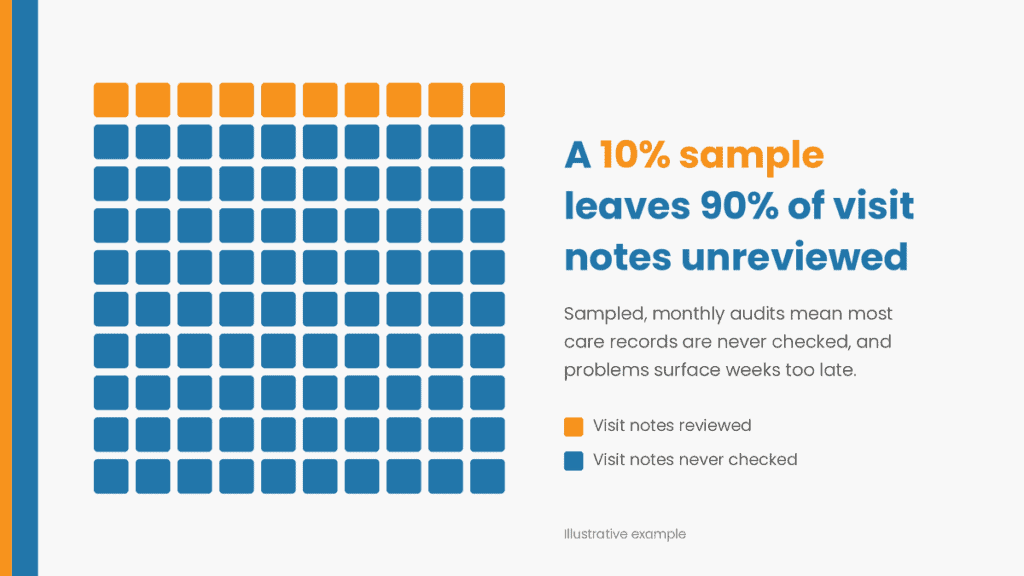
Traditional auditing reviews a sample of records, often monthly, after the care has already happened. If you audit 10% of visit notes, the other 90% go unreviewed. By the time a pattern shows up, it may have affected several people over several weeks.
Sampling made sense when every check was manual. It leaves gaps that inspectors and safeguarding teams are increasingly likely to ask about. Good compliance software should help you review far more of your records, far more often, without adding hours to anyone’s week.
3. It checks the paperwork, not the care
A record can be complete and still show that care has gone wrong. A visit may be logged on time with every field filled in, but if the care delivered no longer matches what the person’s care plan says they need, there is a problem.
This gap between the plan and what actually happens is one of the hardest things to spot manually. It needs someone to compare each person’s plan against what was delivered, day after day, across your whole client base. Software that only checks whether records exist will miss it.
4. Alerts have no clear owner
Some systems raise so many alerts that teams stop paying attention. Others raise alerts that nobody is responsible for closing. Either way, the issue is flagged, but nothing changes and nobody can show what was done about it.
CQC wants to see evidence that concerns were acted on, not just recorded. Every flag should have a named person who closes it, with a clear reason. That trail is often what separates “we knew about it” from “we dealt with it”.
5. Carers find it hard to record well
Compliance software is only as good as the information going into it. If recording a visit is slow or awkward, carers write the minimum. When notes are thin and rushed, compliance software fails to spot concerns, however clever it is.
Ask your carers what slows them down. Their answers will often tell you more about your compliance gaps than any report.

6. Compliance sits in a separate system
When rotas, care plans, visit notes and audits live in different places, information has to be re-keyed or reconciled by hand. Every handover between systems is a chance for something to be missed.
Compliance works best when it draws on the same records your team already uses to plan and deliver care, so nothing has to be copied across and checked twice.
How to tell if your compliance software fails to give real assurance
Ask yourself these questions honestly:
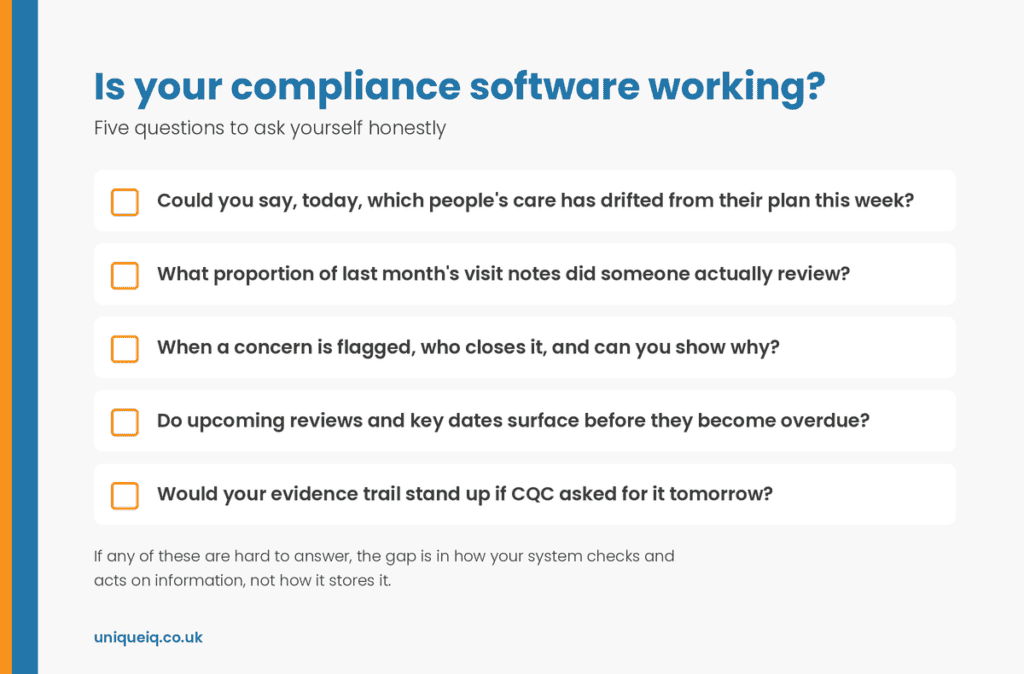
- Could you say, today, which people’s care has drifted from their plan this week?
- What proportion of last month’s visit notes did someone actually review?
- When a concern is flagged, who closes it, and can you show why?
- Do upcoming reviews and key dates surface before they become overdue?
- Would your evidence trail stand up if CQC asked for it tomorrow?
If any of these are hard to answer, the gap is likely in how your system checks and acts on information, not in how it stores it. The Homecare Association also publishes useful guidance for providers on governance and quality.
How Unique IQ approaches compliance auditing
IQ:careaudit is an optional AI add-on to IQ:caremanager, built to close the gaps where compliance software fails. It works in two ways.
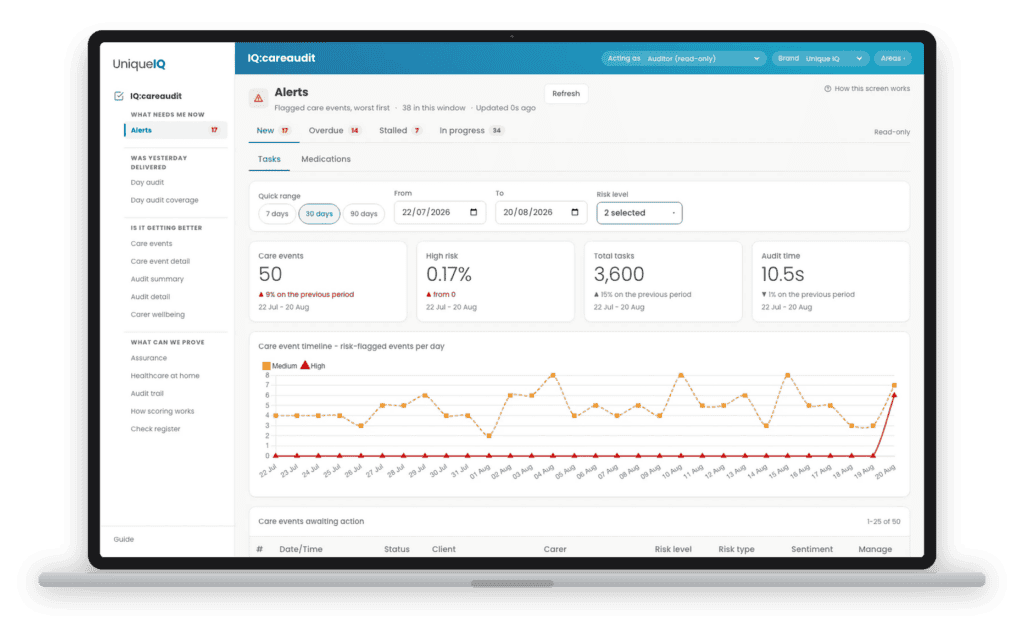
First, it reads visit notes, visit logs and medication records as they are submitted, and flags risks so they can be dealt with before they escalate.
Second, it audits the whole care day. Each night, it runs more than 40 rules and signals across your entire client base and checks the care delivered against each person’s own care plan. The next morning, your team can see four things: care that has drifted from the plan, reviews and key dates that are upcoming or overdue, safeguarding, compliance, missed medication or incomplete record signals in the notes, and early signs of carer strain.
Nothing is closed automatically. Every finding is closed by a named person with a reason, so you build an evidence trail as you work. Providers using IQ:careaudit have reduced auditing time by 95% or more.
IQ:careaudit supports compliance and inspection readiness. It does not replace your team’s judgement. It gives them the time and the information to use that judgement where it matters most.
See how IQ:careaudit could close your compliance gaps. Book a demo with our team, or call us on 0800 888 6868 and choose option 1 to speak to a real person.

Frequently asked questions
What is home care compliance software?
Home care compliance software helps providers monitor care quality, safety and record keeping, and build the evidence CQC expects to see. It usually covers audits, alerts, reviews and reporting, and works best when it is part of the same platform used to plan and deliver care.
Why compliance software fails in home care
Compliance software fails when it stores records without checking them, relies on small samples, checks paperwork rather than care against the plan, or raises alerts that nobody owns. The software works, but the process around it does not.
Can compliance software guarantee a good CQC rating?
No. Software can support inspection readiness and make evidence easier to produce, but ratings depend on the quality of care, leadership and governance across your whole service.
How often should home care records be audited?
There is no single required frequency, but Regulation 17 expects systems that monitor quality and safety effectively. Reviewing records continuously, rather than sampling them monthly, gives a much clearer and more current picture.
Does compliance software replace a registered manager’s oversight?
No. It should reduce the time spent searching for problems so managers can spend more time resolving them. Decisions and accountability stay with your team.