

The benefits of runs and rounds for home care providers
Rounds in home care are one of the simplest ways to bring order to a complex scheduling process. Running a care company is a juggling act that demands constant oversight: knowing the skill set of each carer, the needs of every client and the availability of your entire workforce means those responsible for scheduling carry a great deal on their shoulders. That is where rounds in home care can help, grouping recurring visits into predictable, efficient schedules that work for everyone.

What are runs and rounds in a home care setting?
Some care companies create their rotas with a framework called runs or rounds. And while the terminology sounds different, runs and rounds are essentially the same thing – a helpful way of grouping a block of recurring visits on any given day into a logical schedule for a carer to attend on a shift. Rounds help create defined and predictable schedules- helping to provide consistency for carers and clients and helping businesses save travel time costs.
How do runs and rounds work?
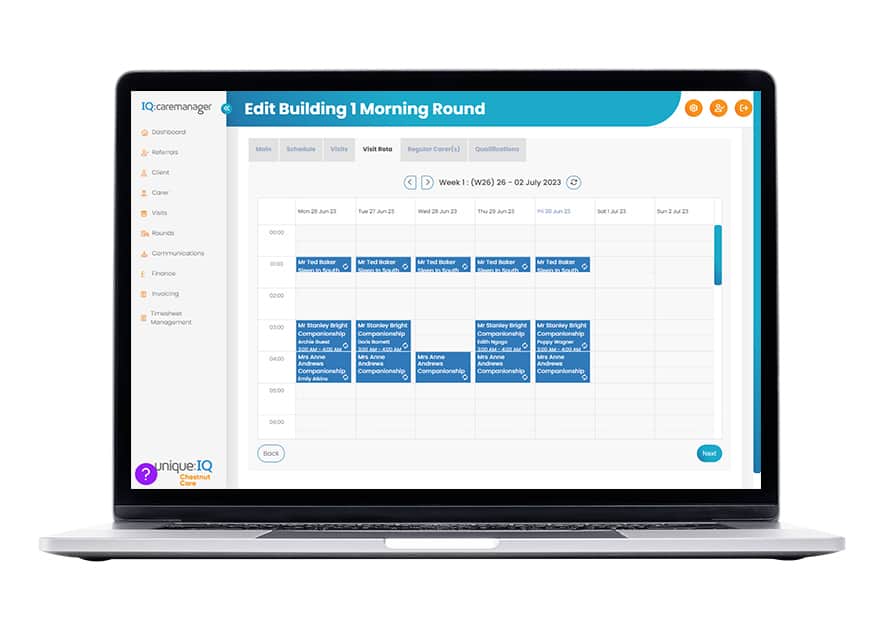
In the past, shift plans were likely created manually using timesheets and a pin board, but these days, comprehensive home care scheduling software like IQ:caremanager can do the heavy lifting.
Essentially, once recurring care visits are added to the visit diary they can be selected like a pick and mix of visits and collated into a clock of visits for a carer to attend. Rounds can be repeated in pretty much any format required – daily, weekly, monthly or alternate between different carers to offer variety.
Runs or rounds are typically grouped by geographical location, client requirement, client skill, period or visits that require double-ups. Some clients may create a round that is specifically for clients that all require meal preparation or peg feeds – playing to the strengths and skills of the carers available.
The benefits of using rounds in-home care scheduling
- While it may take some preparation time to set up, once it is ready the amount of time spent scheduling will drastically decrease
- Carers are assigned a regular, predictable schedule that may offer some consistency to their working week
- Clients will be assigned a regular carer with who they are familiar with – which may have a positive impact on their quality of care
- Rounds can be set up to ensure that mileage is taken into consideration – ensuring that shifts are as efficient as possible
Rounds in home care scheduling offer several benefits for both care providers and clients. By grouping recurring visits into logical schedules, rounds increase efficiency, save time, and streamline the scheduling process. They provide carers with consistent and predictable schedules, promoting job satisfaction and work-life balance. Clients benefit from having regular carers, leading to improved quality of care and enhanced client-carer relationships. Additionally, rounds enable optimal resource allocation, considering factors such as geographical location, client requirements, and carer skills. By implementing rounds in home care scheduling, care companies can enhance their operations, improve client experiences, and ultimately deliver better care to those in need.
See rounds in action
Ready to take the manual work out of scheduling? IQ:caremanager lets you build rounds in home care in minutes, group recurring visits by location, skill or client need, and give your carers the consistent schedules they deserve. Spend less time on the rota and more time on care.
Book a demo and see how much simpler scheduling can be.
Frequently asked questions
What are rounds in home care?
Rounds in home care are a way of grouping a block of recurring visits on a given day into a single, logical schedule for a carer to complete on a shift. They are sometimes called runs, but the terminology means the same thing. Rounds bring structure and predictability to home care scheduling, helping both carers and clients.
What is the difference between runs and rounds?
There is no real difference. Runs and rounds are two names for the same approach: collecting recurring visits into an organised schedule for a carer to attend. Some care providers say runs, others say rounds, but both describe the same scheduling method.
How do rounds work in home care scheduling?
Once recurring visits are added to the visit diary, they can be selected and grouped into a set of visits for a carer to attend. Rounds can repeat daily, weekly or monthly, or alternate between carers to offer variety. They are usually grouped by geographical location, client requirement, carer skill, or visits that need double-ups.
What are the benefits of using rounds in home care?
Rounds in home care reduce the time spent scheduling, give carers regular and predictable shifts, and help clients see a familiar carer they know and trust. They can also factor in mileage, keeping travel time and costs as efficient as possible.
Can home care software help manage rounds?
Yes. Scheduling software such as IQ:caremanager does the heavy lifting, letting you build, repeat and adjust rounds in minutes rather than managing them manually with timesheets and a pin board.
Do rounds improve consistency of care?
They can. Because rounds assign clients a regular carer, clients often benefit from continuity and stronger relationships, which can have a positive impact on their quality of care.