
In summary
The CQC State of Care 2025/26 report shows 8 in 10 assessed homecare services are rated good or outstanding. It also shows what sets the best apart:
- Continuity: well-planned rotas, realistic travel time and consistent teams, so people know who’s coming.
- Competence: checking that carers can do the job safely, not just that training has been completed.
- Oversight: clear, up-to-date records that let leaders and families see care as it happens.
With 1 in 5 homecare staff leaving their job last year and the market growing fast, getting these right matters more than ever.
CQC State of Care: the good news for homecare
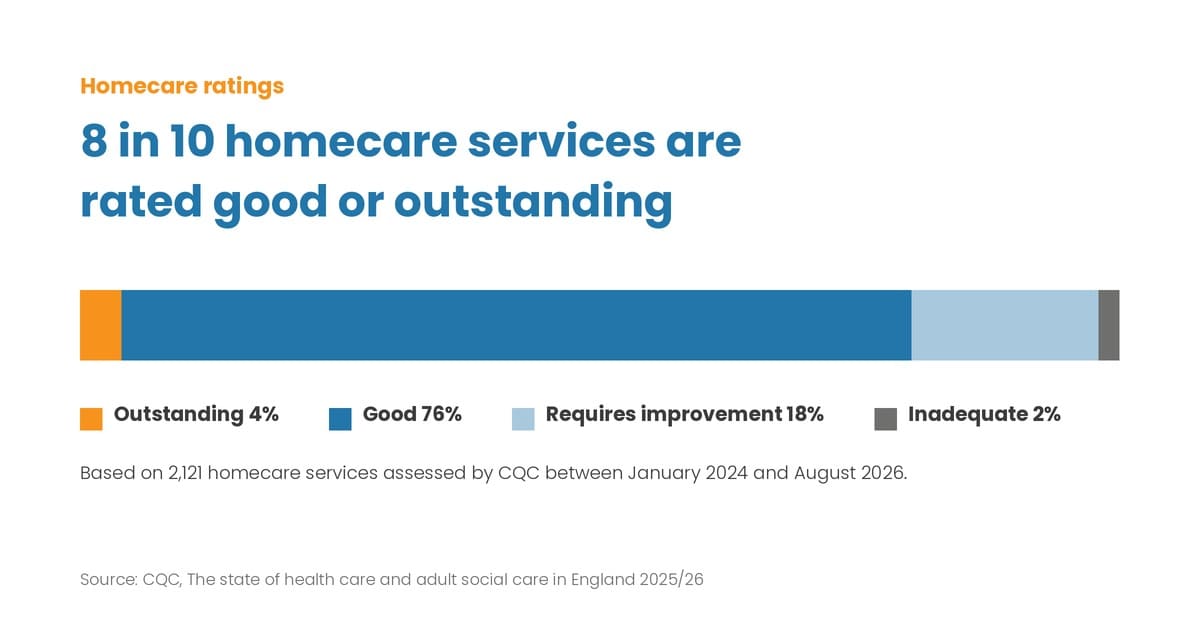
The Care Quality Commission (CQC) published its State of Care 2025/26 report on 23 October 2026, and there’s real good news in it for homecare. Of the 2,121 homecare services CQC has assessed under its current framework since January 2024, 8 in 10 are rated good (76%) or outstanding (4%).
That’s a credit to care teams across the country, who are delivering through sustained pressure on staffing and funding. CQC does note that its assessments have been largely risk based, so the figures may not reflect every service in the sector.
The report is just as useful for what it shows about the difference between services that thrive and those that struggle. Read closely, it paints a clear picture of what outstanding homecare looks like in practice. Here’s what stood out to us, and what it could mean for your service.
A tale of two homecare services
One of the most powerful parts of the report is a personal story. Raymond, who lives with Alzheimer’s disease, received care at home from two different services, and his daughter Joanne saw the difference first hand.
With the first service, carers were often late, didn’t stay for their full visits and regularly missed his medication. There was a constant turnover of unfamiliar faces. As Joanne put it, “You never knew who was coming”.
The second service was a different story. A core team of six carers visits Raymond on time and stays for the whole visit. They log his medication on a mobile app, so Joanne can see exactly what’s been done. His care plan is reviewed regularly and updated as his needs change. The carers, Joanne says, “know him inside out”.
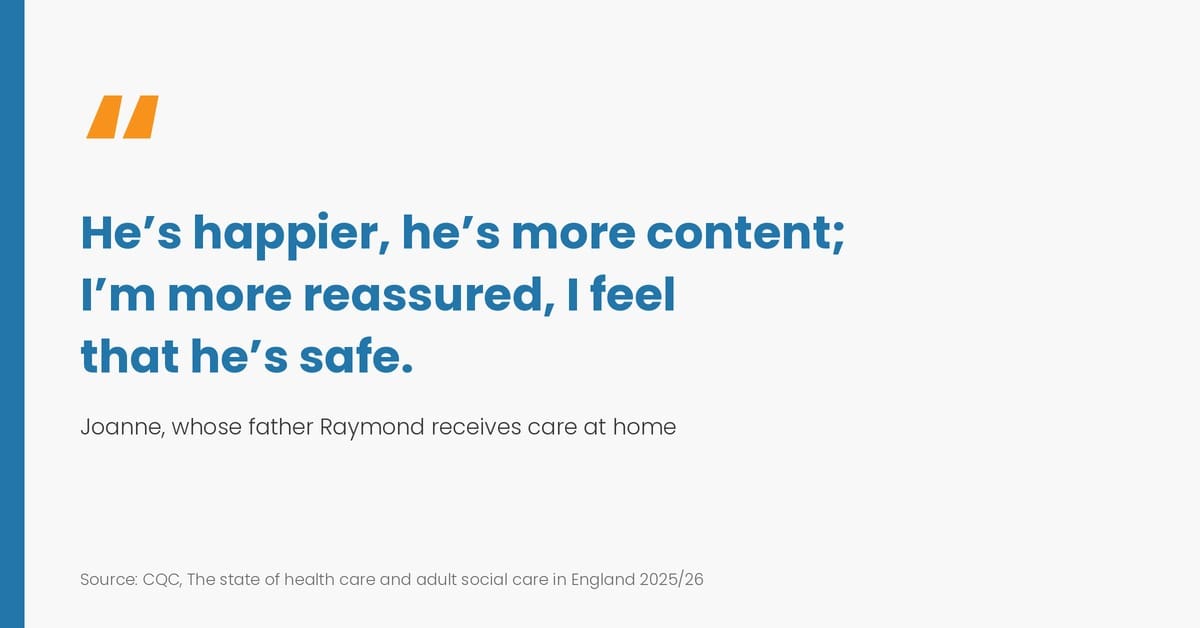
The result? “He’s happier, he’s more content; I’m more reassured, I feel that he’s safe.”
What separated the two services was consistency, competence and clear oversight. Those three themes run right through the report.
Continuity starts with the rota
Across adult social care, including homecare, the CQC State of Care report found that where staffing was well managed, people were much more likely to receive safe, consistent, person-centred care, with meaningful relationships with the people supporting them.
In these services, inspectors saw well-planned rotas, enough travel time between visits, consistent staff teams and good matching of carers to the people they support. Providers also had tools to monitor staffing and respond quickly when someone’s needs changed. One person summed it up simply: “I have never had a stranger walk into my house.”
Where staffing wasn’t well managed, the picture was very different. Rotas sometimes fell below safe levels or didn’t reflect who was actually working, and people experienced delays and inconsistent care.
The lesson is that continuity rarely happens by accident. It’s designed into the rota. Scheduling that accounts for realistic travel time, flags conflicts before they happen and keeps familiar faces with the same people gives carers the time to care, and gives the people they support the reassurance that comes with knowing who’s coming.
Good matching doesn’t have to rely on gut feel either. IQ:careaudit, our AI-powered real-time auditing and alerting tool, reads the tone and sentiment of visit notes as they come in. This helps managers see which carers and clients get on particularly well, and where a relationship might need a little more support. That insight makes it easier to build consistent teams around the people you support, not just around availability.
Trained isn’t the same as competent
In services rated inadequate for safety, CQC found staff didn’t always have the skills, knowledge or competence to meet people’s needs safely. In one case, a newly recruited care worker administered medicine before any competency assessment had been recorded.
Services rated outstanding for safety did things differently. They kept full oversight of training gaps and checked competence regularly through audits, observations of practice and supervision. One outstanding homecare service featured in the CQC State of Care report went further, using a “digital safeguard” on its rostering system. Before a carer could be allocated to someone, the system checked they had the training needed for that person’s specific needs.
We know training isn’t easy to prioritise. The government’s adult social care workforce skills survey, cited in the report, found cost (82%) and time (56%) were the most common barriers to investing in staff skills.
That’s exactly why it helps when your systems do some of the checking for you. If training records sit in one place and the rota in another, making sure the right carer is on the right visit depends on someone remembering. Joining the two up turns good intentions into a reliable process.
Seeing what’s happening, as it happens
In Raymond’s story, much of Joanne’s reassurance came from visibility. She no longer felt the need to check his medicines, because she could see they were being given. In another outstanding service, a relative praised the “meticulous daily reporting” as a key reason for their confidence.
The same applies to leaders. Looking at care homes, CQC inspectors highlighted leaders not having the time and support they need to provide good oversight, and services not listening to staff or acting on their feedback. Homecare managers will recognise the challenge: when care happens across dozens of homes every day, you can’t see it all with your own eyes.
This is where technology can genuinely help. CQC says it encourages the use of innovative technologies, including AI, where they benefit people and make services more effective and efficient. Digital care records and eMAR give families and managers a clear view of care delivered. IQ:careaudit goes a step further here too, reviewing visit notes and medication records as they come in and flagging potential risks, so managers can act before small issues become big ones. It also alerts you to key dates, such as reviews and risk assessments that are coming up or already overdue, so they’re picked up long before an inspection picks them up for you.
Good two-way communication matters too. When carers can easily raise concerns and get a response, leaders hear what’s happening on the ground, and staff feel listened to.
Why the CQC State of Care findings matter for homecare
The homecare market is growing and changing fast. There were just over 13,500 homecare services registered in April 2026, up 42% since 2019, with around 700 new services registered in the last year alone. CQC describes the market as increasingly fragmented, with services supporting 4 or fewer people now making up 30% of the sector.
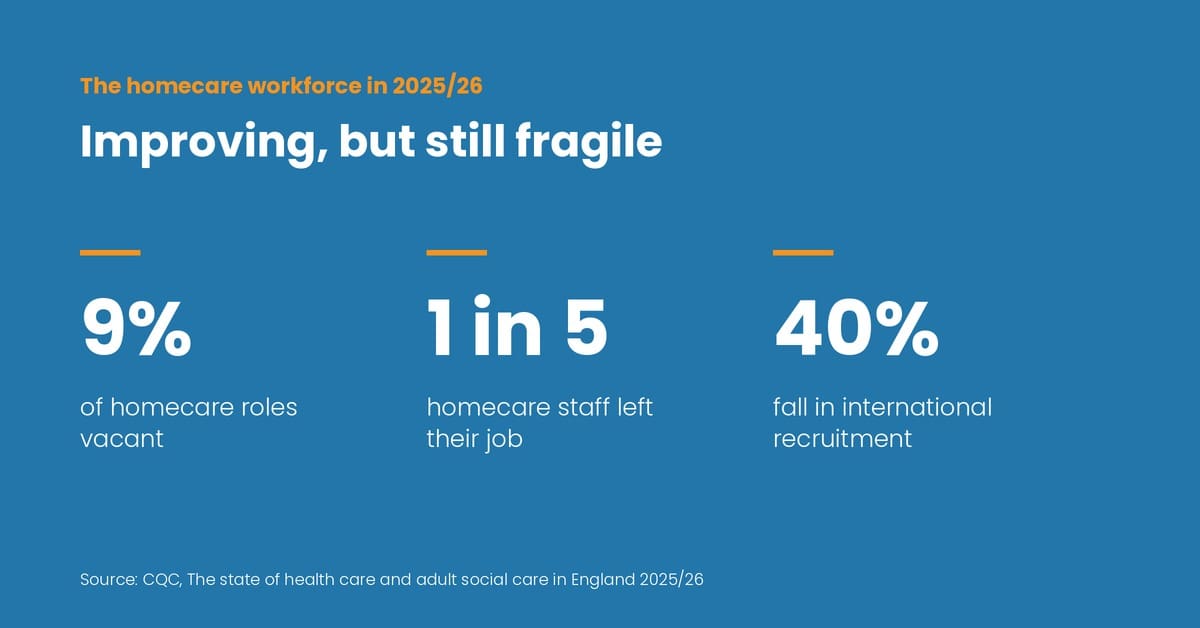
The workforce picture is improving, but remains fragile. Homecare vacancies held steady at 9% in 2025/26, and turnover fell to 19%. That still means 1 in 5 homecare staff left their job during the year. Meanwhile, international recruitment into social care fell by a further 40% to just over 30,000.
In a crowded market with fewer new carers coming in, keeping your team matters as much as finding them. CQC found that services rated outstanding for safety created a culture where staff felt valued and supported, with clear routes to develop their careers. Skills for Care data in the report shows care workers with a relevant qualification were less likely to leave their role (21% compared with 27%).
Spotting when a carer is struggling is a big part of that. Early signs of pressure often show up quietly in everyday records, with visit notes becoming shorter, more rushed or less detailed. IQ:careaudit picks up these patterns as they happen, so managers can offer a supportive check-in before stress turns into absence or a resignation. Find out more in our blog on how AI spots early warning signs in care worker wellbeing.
Consistency, competence and oversight aren’t just what CQC looks for. They’re what helps you keep good carers, win the confidence of families and commissioners, and stand out.
Final thoughts
The best homecare in this year’s CQC State of Care report isn’t defined by any single policy or tool. It’s what happens when good people are backed by good systems: rotas that protect continuity, checks that turn training into competence, and records that give leaders and families a clear view of care as it happens.
At Unique IQ, we’ve been helping homecare providers do exactly that since 2006. If you’d like to see how our care management software and AI tools can support your team, book a demo or call us on 0800 888 6868.
Sources
Care Quality Commission, The state of health care and adult social care in England 2025/26, published 23 October 2026.
Frequently asked questions
What is the CQC State of Care report?
State of Care is the Care Quality Commission’s annual assessment of health care and adult social care in England. It looks at trends, shares examples of good and outstanding care, and highlights where care needs to improve. The 2025/26 report was published on 23 October 2026.
How is homecare rated in the CQC State of Care 2025/26 report?
Of the 2,121 homecare services CQC assessed under its current framework between January 2024 and August 2026, 76% were rated good and 4% outstanding. A further 18% were rated requires improvement and 2% inadequate. CQC notes its assessments have been largely risk based, so the results may not represent every service.
What do outstanding homecare services do differently?
The report points to three themes. Outstanding services plan rotas for continuity, with enough travel time and consistent teams. They check carers are competent, not just trained. And they keep clear, up-to-date records that give leaders and families good oversight of care.
What does the report say about the homecare workforce?
Homecare vacancy rates held at 9% in 2025/26, while staff turnover fell to 19%. That still means 1 in 5 homecare staff left their job during the year. International recruitment into social care also fell by a further 40% to just over 30,000.
How is the homecare market changing?
There were just over 13,500 homecare services registered in April 2026, up 42% since 2019. CQC describes the market as increasingly fragmented, with services supporting 4 or fewer people making up 30% of the sector.
What does CQC say about technology and AI in care?
CQC says it encourages the use of innovative technologies, including AI, where they benefit people and make services more effective and efficient. It has also published a position statement on its role and expectations around AI in health and social care.
How can care management software support CQC readiness?
Good software helps turn good intentions into reliable processes. Smart scheduling supports continuity of care, digital care records and eMAR give a clear view of care delivered, and AI auditing tools can flag potential risks in visit notes and medication records so managers can act early.