

At a glance
A quick summary of what the regulator shared on CQC registration for home care providers at Care Show Birmingham 2026.
- Who CQC registers: providers, meaning the legal entity running the service, to carry on specific regulated activities. For most home care providers, that’s personal care.
- The numbers: between April and August 2026, CQC processed more than 4,600 new homecare provider applications. 74% were rejected at the initial completeness check and just 116 were approved.
- The process: a DBS check through CQC, an application form with a statement of purpose, evidence that you can meet the five key questions and fundamental standards, and supporting policies. CQC then checks for completeness, assesses the application, holds fitness interviews and makes a decision.
- The top tip: make sure your application is complete, accurate and specific to your service before you submit.
- How Unique IQ helps: our care management software and AI tools help home care providers evidence quality against CQC’s five key questions from day one.
Starting a home care service? Here’s what CQC wants you to know
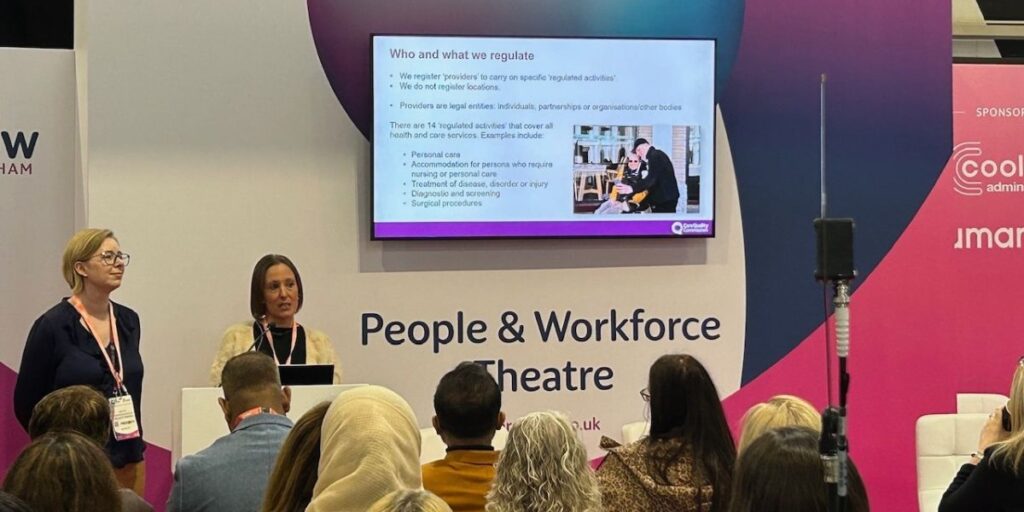
At Care Show Birmingham 2026, we joined a packed People & Workforce Theatre to hear the Care Quality Commission share hints, tips and the latest news on CQC registration for home care providers. Phones were held high to capture every slide, and it was easy to see why.
CQC registration is the front door to delivering regulated care in England. Get it right and you can start supporting people in your community. Get it wrong and your application can be rejected before a registration inspector has even looked at it.
Here’s what we took away from the session, along with our own thoughts on how new and growing home care providers can give their application the best possible chance.
Who and what CQC regulates
CQC registers providers, not buildings. A provider is the legal entity running the service, whether that’s an individual, a partnership or an organisation. Locations aren’t registered on their own; instead, providers are registered to carry on specific regulated activities.
There are 14 regulated activities covering health and care services. Examples shared in the session included:
- Personal care
- Accommodation for persons who require nursing or personal care
- Treatment of disease, disorder or injury (TDDI)
- Diagnostic and screening procedures
- Surgical procedures
For most home care providers, personal care is the activity that matters. If your service will also include nursing or clinical tasks, check early which activities apply to you. Applying for the right activities from the outset saves time later.
The numbers: most applications fall at the first hurdle
The headline from the session was stark. Between April and August 2026, CQC’s registration team processed more than 4,600 new homecare provider applications. Here’s what happened to them:
- 74% (3,438) were rejected at the initial completeness check
- 11% (529) progressed to assessment
- 40 of those assessed were refused at the grant or refuse stage
- Just 116 applications were approved
In other words, around three in every four applications never reached a registration inspector, because something was missing or incomplete. Most failed early, and very few made it through to approval.
For context, there are currently 14,014 providers registered for personal care and TDDI, of which 10,698 provide personal care only. Across services, there are 14,271 registered personal care locations, including 841 dormant locations.
The process of CQC registration for home care providers
CQC walked through the journey in two halves: what you submit, and what happens once it lands with them.
What you submit
- DBS check through CQC. Before applying, both provider and manager applicants must obtain a Disclosure and Barring Service (DBS) check through CQC. This matters later, as it’s part of the completeness check.
- Application form. Providers and managers complete an application that includes a statement of purpose, which must be accurate and complete. CQC wants to know who you are (your history, skills and experience), what you intend to provide (your regulated activities) and where you’ll provide it (your location).
- How you’ll meet the core regulations. You need to demonstrate that you can meet CQC’s five key questions (safe, effective, caring, responsive and well-led) and the fundamental standards.
- Supporting information. CQC asks for a range of supporting documents, including policies. These must contain enough detail to be assessed and are reviewed alongside your application. If any document doesn’t meet the minimum requirements set out on CQC’s website, the application will be rejected.
What happens next
- Completeness check. On receipt, CQC checks your application is complete. If anything is missing, it’s rejected at this stage.
- Assessment. Complete applications are allocated to a registration inspector, who assesses them against CQC’s assessment framework to decide whether the core regulations have been met.
- Fitness interviews. Both the provider and the manager are interviewed.
- Grant or refuse. CQC makes its final decision.
Our top tips on CQC registration for home care providers
With so many applications falling at the completeness check, a little extra preparation goes a long way. Here’s what we’d suggest, based on CQC’s session and our conversations with home care providers.
- Treat the completeness check as your real deadline. Before you submit, check every item against CQC’s published requirements. One missing document can send you back to the start.
- Get DBS checks done early. Both the provider and the manager need one through CQC, so build this into your timeline from day one.
- Make your statement of purpose specific. Set out clearly who you’ll support, the regulated activities you’ll carry on and the area you’ll cover. Vague or generic wording makes it harder for CQC to assess.
- Tailor your policies to your service. Template policies can be a helpful starting point, but CQC needs to see how they’ll work in practice for you. Reference your own roles, processes and escalation routes.
- Map your plans to the five key questions. For safe, effective, caring, responsive and well-led, be ready to explain what you’ll do and how you’ll know it’s working.
- Keep your details consistent. Names, addresses, regulated activities and service descriptions should match across every document you submit.
- Prepare for the fitness interview. Both provider and manager should know their policies inside out and be able to talk confidently about how the service will run day to day.
How Unique IQ can help, from application to inspection
Registration is the starting line, not the finish. Once you’re registered, CQC will expect to see the systems you described working in practice: person-centred care plans, accurate visit and medication records, regular audits and clear oversight from leaders.
Software won’t complete your application for you, but choosing your systems early makes a real difference. It helps you explain clearly, in your application and your fitness interview, how you’ll keep records and monitor quality. And once you’re up and running, the evidence builds as part of everyday care, rather than being pieced together before an inspection.
Here’s how our care management platform, IQ:caremanager, and our AI tools support each of CQC’s five key questions.
Safe
Digital risk assessments and eMAR give your team a clear, accurate record of each person’s care and medication. Missed visit alerts let the office act quickly when a call is running late. IQ:careaudit reviews visit notes as they come in and flags potential risks, while its day audit checks the previous day’s delivered care against each person’s care plan, so nothing slips through unnoticed.
Effective
IQ:capture records and transcribes assessments, reviews and handovers into structured summaries, using pre-loaded CQC-aligned templates, with the choice to store recordings locally or in the cloud. Those summaries feed into IQ:careassist, which helps you draft detailed, person-centred care plans in a fraction of the time. Every version is tracked, so you can always see what changed and when.
Caring
Good care starts with knowing the person. IQ:careassist works from context, including your organisation’s own guidance, so care plans sound like your organisation while still reflecting the people they’re about. You can write in the first or third person and set the tone for each section. You can also complete risk assessments and other key care documents in IQ:careassist, using CQC-aligned templates that help you capture the right information from the start. Every change to a care plan is logged and time-stamped, so you have a clear record of what changed, when and by whom, helping you meet CQC’s expectations for accurate, up-to-date records. Carers can then see what matters to each person on our carer app, wherever they are.
Responsive
Our scheduling and rostering tools help you match the right carer to the right visit, with conflict detection, travel time calculations and rolling rotas that you build once and carry forward. When plans change, secure messaging using IQ:messenger between the office and carers keeps everyone up to date.
Well-led
Compliance dashboards, audit trails, live reporting and a custom report builder give leaders a clear view of quality across the service, along with support for your CQC Provider Information Return. Our AI tools are designed with CQC guidance in mind too: IQ:capture uses CQC-aligned templates, IQ:careassist helps keep care plans detailed and person-centred, and IQ:careaudit highlights risks and gaps in care, giving leaders the oversight to act early. Role-based permissions, two-factor authentication and Defined Access Rights mean the right people see the right information, whether you run one branch or many.
More than software
We’ve supported home care providers since 2006, from new start-ups to multi-branch groups. Timesheets, invoicing, payroll integration and expenses all sit in the same platform, giving managers more time to focus on care. When you call us, you’ll always speak to a real person who understands domiciliary care. And our customers help shape what we build next, so the platform keeps growing with the sector.
Final thoughts
CQC’s message was clear: when it comes to CQC registration for home care providers, most applications fall short because they’re incomplete, not because the provider isn’t capable of delivering good care.
A big thank you to the CQC team for such a practical session at the People & Workforce Theatre, and to everyone who stopped by our stand at Care Show Birmingham.

Planning a new home care service or getting ready to grow? Book a demo to see how Unique IQ can help you evidence quality from your very first visit.
Frequently asked questions
Is CQC registration for home care providers a legal requirement?
Yes. If you provide personal care to people in their own homes in England, you must be registered with the Care Quality Commission before you start delivering that care. CQC registers the provider, meaning the legal entity running the service, to carry on specific regulated activities.
What are the requirements of CQC registration for home care providers?
Both the provider and the manager need a DBS check through CQC before applying. You’ll then submit an application form with a statement of purpose, evidence of how you’ll meet CQC’s five key questions and the fundamental standards, and supporting information such as your policies.
Why are so many CQC registration applications rejected?
Most applications are rejected because they’re incomplete. Between April and August 2026, 74% of new homecare provider applications were rejected at CQC’s initial completeness check, before reaching a registration inspector. Missing information, or documents that don’t meet CQC’s minimum requirements, are the main reasons.
What are CQC’s five key questions?
CQC asks whether services are safe, effective, caring, responsive and well-led. Your application needs to show how your service will meet each one.
What is a CQC fitness interview?
Once your application has been assessed, CQC holds fitness interviews with both the provider and the manager. It’s your chance to show you understand your policies and how your service will run day to day.
Can care management software help with CQC registration?
Software won’t complete your application for you, but choosing your systems early helps you explain clearly how you’ll keep records and monitor quality. Once you’re registered, care management software such as Unique IQ helps you evidence quality against the five key questions as part of everyday care.