
In summary
The Department of Health and Social Care’s guidance on using AI in adult social care, published in September 2026, sets out best practice for care providers. This was followed by wider government guidance in November, jointly published by DHSC and the Department for Education, covering AI across children’s and adults’ social care. Together, they give providers a clearer picture of how to adopt AI safely and responsibly.
- Keep a human in the loop: always have a person review anything AI produces.
- Have an AI policy: even if your policy is that staff can’t use AI at work.
- Protect people’s data: never put personal information into free or public AI tools.
- Bring your team with you: train staff and consider appointing digital champions.
It sits neatly alongside CQC’s own principles for AI, and CQC’s latest State of Care report confirms the regulator continues to encourage AI where it benefits people.
What’s changed since the CQC’s AI statement?
In May 2026, CQC published its first formal statement on AI, and we looked at what the CQC AI guidance means for home care at the time. The headline was encouraging: the regulator welcomes AI where it benefits people, as long as human oversight and good governance come with it.
Since then, the government has filled in more of the practical detail. On 29th September 2026, the Department of Health and Social Care (DHSC) published its best practice guidance for adult social care providers, setting out how organisations can approach AI safely and responsibly.
Then, in October, CQC’s State of Care 2025/26 report confirmed its stance. CQC says it encourages innovative technologies, including AI, where they benefit people and make services more effective and efficient, and that it will keep exploring what providers’ use of AI means for how it registers, assesses and rates services.
New government guidance: a wider approach to AI in social care
On 20th November 2026, the Department of Health and Social Care (DHSC) and Department for Education (DfE) published new cross-sector guidance on the use of artificial intelligence in social care.
Titled Artificial intelligence (AI) in social care, this is the first national guidance covering the use of AI across both children’s and adults’ social care in England.
While the September guidance focused specifically on adult social care, this latest publication takes a wider approach, setting out the government’s position on how AI can be adopted and used safely and responsibly across the social care sector.
It is primarily aimed at local authorities, but its principles are also relevant to other organisations delivering social care, including independent home care providers.
The guidance highlights several important areas for organisations considering AI, including:
- Governance and accountability: ensuring organisations take responsibility for how AI is introduced, managed and monitored.
- Data protection: protecting people’s personal information and ensuring AI is used appropriately.
- Professional oversight: keeping practitioners involved and ensuring human judgement remains central to decisions about people’s care.
- Safe and responsible adoption: understanding the benefits and risks of AI before introducing it into everyday practice.
For home care providers, the message is clear: AI has the potential to reduce administrative workloads, improve access to information and give care professionals more time to focus on people. However, these benefits must be balanced with appropriate safeguards, transparency and human oversight.
The new guidance reinforces the importance of having a clear approach to AI adoption, rather than introducing tools without fully understanding how they work, what information they use and how their outputs are checked.
So, what does all of this mean for home care providers already using AI in social care, or thinking about introducing it? Here’s our round-up of the key things to consider.
Where AI is already being used in adult social care
The DHSC guidance is candid that many providers are still in the early stages of exploring AI. But it also highlights a wide range of uses already in place, including:
- Care planning and assessments, where AI can fast track high workload tasks such as writing care plans, auditing, daily monitoring and logging data.
- Sensors and monitoring, from tracking vital signs to detecting changes in how someone walks that may suggest a higher risk of falls.
- Data analytics, spotting patterns in incidents or behaviour that people might miss.
- Auditing tools, which some providers use across multiple sites to summarise completed audits and flag anything still outstanding.
- Admin and HR, from meeting notes to recruitment and onboarding.
The common thread is time. The guidance notes that AI tools may cut down the time spent on admin, giving care staff more time to spend with the people they support.
It’s also honest about the limits. For example, it says evidence that generative AI can create truly personalised care plans is currently limited, and that a member of care staff must review any AI-assisted plan to make sure it’s accurate.

How the guidance fits with CQC’s expectations
The good news is that the DHSC guidance and CQC’s principles point in the same direction. CQC’s statement sets out principles providers should follow, including:
- AI to support, not replace: AI can enhance human decision making, but not replace it.
- Human oversight: AI outputs and processes are monitored and evaluated.
- Transparency and choice: people know the role AI plays in their care.
- AI readiness and training: staff are trained and confident using it.
- Effective governance: risks are assessed, and there are clear systems for spotting, reporting and learning when something goes wrong.
CQC is also clear on one point that often worries providers: the absence or presence of AI does not predict a specific rating. Using AI won’t win you a better rating on its own, and not using it won’t count against you. What matters is whether it helps you deliver safe, high-quality care.
Seven practical steps on using AI in adult social care for home care providers
Drawing on the DHSC best practice guidance, here are seven steps to help you use AI safely and confidently.
1. Write an AI policy
The guidance says all organisations should consider having an AI policy, even if that policy is that staff can’t use AI for work. It should cover how different roles interact with AI, who is accountable for its use and how outputs are reviewed. Share it with your team so everyone knows where they stand.
2. Always keep a human in the loop
DHSC recommends a human review of anything AI produces, to make sure it’s accurate, fair and in line with your policies. Define who reviews what, and when.
3. Get your data right
AI is only as good as the information it’s given. Accurate, complete and well-organised records make for more reliable results, which is one more reason to keep visit notes and care records up to date.
4. Protect people’s data
Make sure any AI tool complies with UK GDPR. Understand where data is processed, how it is stored, who can access it and how people’s information is being used. Providers should also be transparent with the people they support about how their data is processed. The guidance is clear that you shouldn’t put personally identifiable information into free or online tools, because you have no contract guaranteeing how that information will be used. If in doubt, ask your software supplier.
Consider completing a Data Protection Impact Assessment (DPIA) before introducing AI tools, particularly where personal or sensitive information is involved. This helps identify potential risks to people’s privacy and establish appropriate safeguards.
5. Choose tools with a clear purpose
Start with what you want to achieve, not the technology. The guidance suggests writing a short specification, asking the people you support and your staff for their views, weighing up benefits and risks, and agreeing measurable outcomes. Factor in the full cost too, including training and any changes to how you work.
6. Bring your team with you
Staff confidence makes or breaks any new technology. As well as training, the guidance suggests identifying digital champions who can support colleagues and help new systems bed in smoothly.
7. Watch for bias and keep improving
AI can reflect biases in the data it learns from, so keep an eye on whether outputs are fair for everyone you support. Gather feedback from the people reviewing AI outputs, and adapt your approach as tools and your service evolve.

What this looks like in practice
Choosing AI tools designed around the realities of adult social care can also help providers build governance, human oversight and data protection into everyday processes, rather than trying to manage these considerations separately.
At Unique IQ, we built our AI tools around the same principles the regulator and government are now setting out. Our AI is built into the Unique IQ platform rather than bolted on, so care data stays within one secure environment instead of being passed to separate external tools.
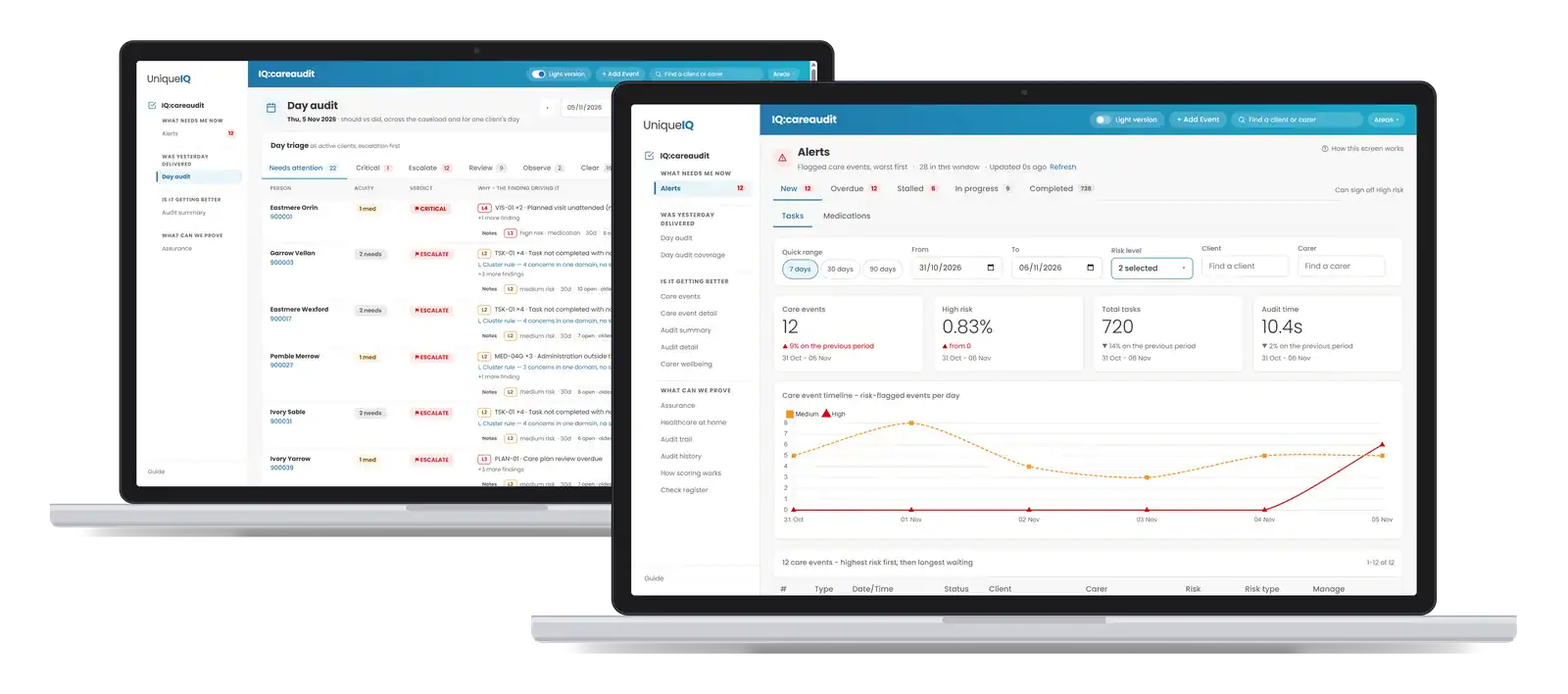
IQ:careaudit, our AI-powered real-time auditing and alerting tool, reviews visit notes and medication records as they come in and flags potential risks. It surfaces what needs attention, but the decision and any follow-up always sit with the manager. That’s the human in the loop, built in.
IQ:careassist co-authors care plans alongside your team, never instead of them, so a member of staff always reviews and shapes the final plan. This reflects the guidance’s emphasis on professional oversight and keeping human judgement at the centre of care decisions.
And because both tools work from the records your team already keeps, getting your data right (step 3) helps you get more from them.
Frequently asked questions for using AI in social care
Is there new guidance on using AI in adult social care?
Yes. Two important government guidance documents were published in 2026. On 29 September, the Department of Health and Social Care published guidance specifically for adult social care providers. On 20 November, DHSC and the Department for Education published wider guidance covering AI across children’s and adults’ social care in England. Both provide recommendations to support safe and responsible AI adoption.
Does CQC allow care providers to use AI?
Yes. CQC encourages innovative technologies, including AI, where they benefit people and result in more effective and efficient services. It expects AI to support rather than replace human decision making, with human oversight and good governance in place.
Will using AI affect my CQC rating?
Not on its own. CQC says the absence or presence of AI does not predict a specific rating. What matters is whether AI helps you deliver safe, high-quality, person-centred care.
Do care providers need an AI policy?
The DHSC guidance says all organisations should consider having one, even if the policy is that staff can’t use AI for work. A policy helps staff understand your stance, who is accountable and how AI outputs are reviewed.
Can care staff use free AI tools like chatbots?
The guidance warns against putting personally identifiable information into free or online AI tools, because there’s no contract guaranteeing how that information is used. Purpose-built care software with proper data protection in place is a safer route.
How should home care providers choose an AI tool?
Start with what you want to achieve, involve your staff and the people you support, compare the benefits and risks, and agree measurable outcomes. Check where data is processed, how outputs are reviewed and the full cost, including training.
Final thoughts
The direction of travel is clear. Both the regulator and the government want AI in adult social care to free up time, surface risks earlier and support better care, with people firmly in control. For home care providers, the steps are practical and achievable: a clear policy, human review, good data, strong data protection and a team who feel confident using the tools.
If you’re ready to take the next step, download our free whitepaper, Governance, Safety and Readiness for AI in Care, for a practical readiness checklist built for home care. Or book a demo or call us on 0800 888 6868 to see our AI tools in action.
Sources
Department of Health and Social Care, Read the full DHSC guidance, published 29 September 2026.
Department of Health and Social Care, Read artificial intelligence (AI) in social care published 20 November 2026
Care Quality Commission, Artificial intelligence in health and social care: CQC’s role, expectations and plans, May 2026.
Care Quality Commission, The state of health care and adult social care in England 2025/26, published 23 October 2026.