
Summary:
Working out how to choose home care rostering software? Look beyond the demo and ask how the system performs week to week. The five questions that matter most are:
- Does the rota roll forward automatically from each client’s pattern of care?
- Are changes handled as exceptions, without breaking the regular schedule?
- Do confirmed visits flow straight into payroll and invoicing?
- Is rostering part of the same platform as care planning and compliance?
- Will you speak to a real person when you need support?
Your rota is the heart of your care business. It decides who goes where and when, what gets invoiced and when carers get paid. So when you’re working out how to choose home care rostering software, the right questions matter far more than the slickest demo.
If you’re reviewing your current system, here are five questions worth asking every one of them.
Why it matters how you choose home care rostering software
Rostering touches almost every part of a domiciliary care business. Get it right and coordinators spend their time on continuity and quality. Get it wrong and hours disappear into rebuilding rotas, chasing changes and reconciling data between systems.
A good demo will always look smooth. These questions help you see how a system performs on an ordinary Monday morning, which is what really counts.
1. Does the rota roll forward automatically, or does someone rebuild it every week?
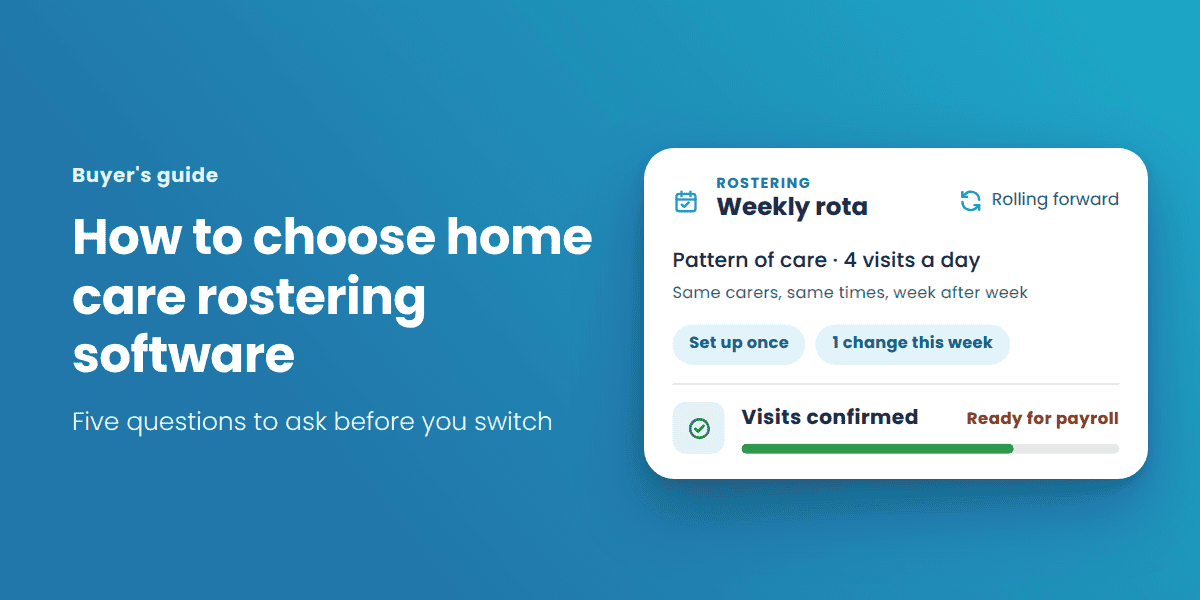
Most people receiving home care have a regular pattern of visits. The same times, the same days and ideally the same carers. Good rostering software should let you set that pattern up once and have the rota roll forward on its own.
If your coordinators are copying last week’s rota into next week, you’re losing hours of skilled time to admin. You’re also creating room for errors to creep in as old mistakes get carried forward.
Ask the supplier: “Once I’ve set up a client’s pattern of care, what do I need to do each week to keep the rota running?” The best answer is: very little.
2. How does it handle changes without breaking the pattern?
Real life doesn’t follow a template. Clients go into hospital, packages increase, carers take annual leave. What matters is how easily your software handles these changes.
Look for a system that treats changes as exceptions to the pattern rather than forcing you to rebuild it. A one-off visit or a cancelled call should be quick to record, clearly visible, and shouldn’t disturb the regular schedule underneath. When the client’s routine returns to normal, so should the rota.
Ask the supplier: “If a client goes into hospital for two weeks, show me how I pause their visits and bring them back.”
3. Do confirmed visits flow straight into payroll and invoicing?
This is where many providers lose time without realising it. If visit data has to be exported, re-keyed or reconciled between separate systems before you can pay carers or invoice commissioners, every week carries extra admin and extra risk.
In a connected system, confirmed visits flow straight through to timesheets and invoices. Your finance team works from the same data your coordinators do, so there’s one version of the truth.
Ask the supplier: “Walk me through what happens between a carer completing a visit and that visit appearing on an invoice and a payslip.”
4. Is rostering part of the same platform as care planning and compliance?
Separate systems for scheduling and care records might seem manageable, but the gaps between them are where things get missed. When a care plan changes, does the person building the rota know about it? When CQC asks for evidence, can you see visits, notes and care plans together?
A single platform means your office team, carers and managers are all working from the same record. That makes day-to-day coordination simpler and inspection readiness far less stressful.
A single platform means your office team, carers and managers are all working from the same record. That makes day-to-day coordination simpler and inspection readiness far less stressful. Continuity of care is also something inspectors look at directly, as part of the CQC’s single assessment framework.
Ask the supplier: “Is rostering built into the same platform as care planning, or is it a separate product that connects to it?”
5. Who picks up the phone when something goes wrong?
Rostering problems rarely wait for a convenient moment. A carer calls in sick at 6am, a run doesn’t look right on a Friday afternoon. When that happens, you need a real answer, quickly.
Ask how support works in practice. Will you speak to a person who understands home care, or join a ticket queue? Do they help you move your existing rotas across when you switch, or leave you to rebuild them?
Ask the supplier: “If I ring you at 8am on a Monday with a rota problem, who will I speak to?”
Looking at your platform as a whole? Our independent evaluation framework covers trust, security and long-term partnership.
How Unique IQ approaches rostering
At Unique IQ, rolling rotas have been part of everyday life for our customers for many years. You set up each person’s pattern of care once, the rota rolls forward, and your team only touches what genuinely changes. Confirmed visits flow through to timesheets and invoicing, all within the same platform as care planning, compliance and reporting. Find out more about our care rostering software.
And when you call us, you speak to a real person. We’ve been supporting home care providers since 2006, and our customers help shape what we build next.
Coming soon: intelligent scheduling
A rolling rota takes care of the pattern. But what about the mornings when the pattern breaks?
We’re building intelligent scheduling into the Unique IQ platform to help coordinators respond faster when things change. When a carer calls in sick, it reworks the affected visits in moments, applies the straightforward changes and flags anything that needs a human decision, such as introducing a new carer to someone with higher needs. Every change comes with a clear reason, and your coordinators stay in control.
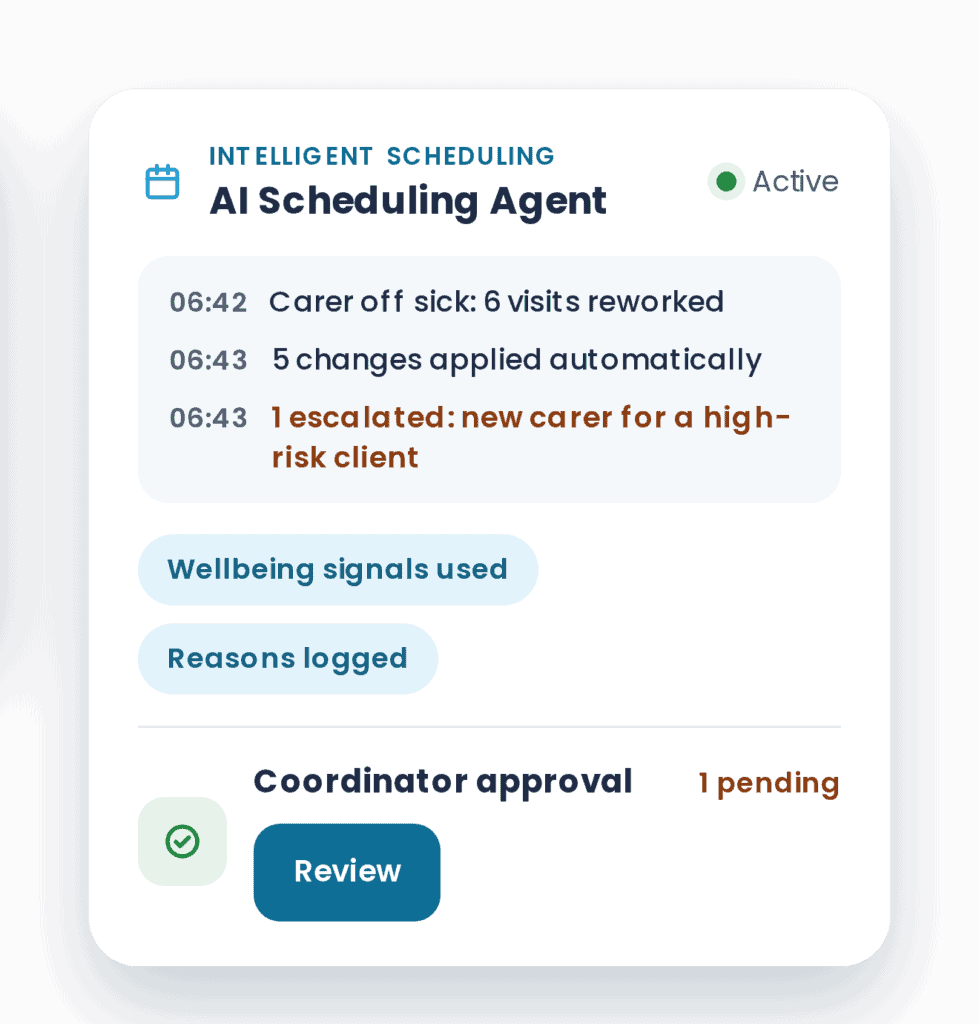
It’s AI where it counts, with people firmly in the loop.
Bring these five questions to a demo and put us to the test. We’ll show you how IQ:caremanager brings rostering, electronic call monitoring, care records and compliance together on a single platform, using real scenarios from your agency.
How to choose home care rostering software: FAQs
How do I choose home care rostering software?
Start with how the system handles your everyday reality rather than its feature list. Check whether the rota rolls forward automatically, how changes are handled, whether visits flow into payroll and invoicing without re-keying, whether rostering sits in the same platform as care planning, and what support you’ll receive when something goes wrong.
What is home care rostering software?
Home care rostering software helps domiciliary care providers schedule carers to visits, manage travel between calls, handle changes and absences, and pass visit data through to payroll and invoicing.
What is a rolling rota in home care?
A rolling rota is built from each client’s regular pattern of care, so the schedule continues automatically week after week. Coordinators only need to deal with genuine changes rather than rebuilding the rota each week.
What questions should I ask a care software supplier about rostering?
Ask what you need to do each week to keep the rota running, how the system handles a client going into hospital, how a completed visit reaches invoicing and payroll, whether rostering is part of the same platform as care planning, and who you’ll speak to when you need support.
Should rostering be in the same system as care planning?
Having rostering and care planning in one platform means coordinators, carers and managers work from the same record. It reduces the risk of changes being missed between systems and makes it easier to evidence care during a CQC inspection.
How long does it take to switch home care rostering software?
It varies by provider size and the system you’re moving from. Ask any supplier what support they provide with data migration, training and go live, and how long a provider of your size typically takes.