
Home support regulation in Ireland arrives through the Health (Amendment) (Home Support Providers) Bill 2025, which passed both Houses of the Oireachtas in June 2026, introducing statutory registration and inspection for every provider in the country. For care leaders, this is a defining moment, and the providers who prepare early will be the ones who move through it with confidence.
A note on scope: this article concerns home support providers in the Republic of Ireland, who will be regulated by HIQA. Northern Ireland is a separate jurisdiction, where domiciliary care is already regulated by the Regulation and Quality Improvement Authority (RQIA) under different legislation. The Bill discussed here does not apply to Northern Ireland providers.
What the new legislation actually does
The Bill amends the Health Act 2007 to create a registration framework for all home support providers, whether public, private or voluntary. In practical terms, it will become an offence to deliver a home support service without being registered, and existing providers will be brought into the system through transitional arrangements.
Oversight sits with the Health Information and Quality Authority (HIQA) and its Chief Inspector of Social Services. HIQA is developing national quality standards, which sit alongside minimum requirements set out in Ministerial regulations. The Chief Inspector will maintain the register, inspect providers, and monitor compliance against both the standards and the regulations. Where serious breaches are found, enforcement can extend as far as suspending or cancelling a provider’s registration.
It is a genuine shift. Until now, home support in Ireland has been a non-statutory service. This legislation brings it in line with how residential care is already regulated, and with best practice internationally.
Why home support regulation matters for the sector
Regulation of this kind does more than raise the compliance bar. It changes how quality is judged, how trust is earned, and how providers compete.
Families and referrers will increasingly look for evidence that a provider is registered and inspected. Commissioners will expect it as standard. And in a growing market, where the HSE has committed to 27 million hours of home support in 2026, the ability to demonstrate consistent, accountable, high-quality care becomes a real commercial advantage, not just a legal obligation.
The providers who treat this as an opportunity to strengthen governance, rather than a box to tick, will be best placed to grow.
The preparation window is now
Here is the part that matters for planning. The Bill has passed both Houses, but it still needs to be signed into law by the President, after which the Minister for Health will set a commencement date. The requirements are not live yet.
Once the legislation is enacted, existing providers are expected to have a transitional period of two years to apply for initial registration, with registration then lasting three years before renewal. That sounds like plenty of time, but readiness is not something you can switch on overnight. Demonstrating compliance means having governance, record-keeping, care planning, and audit processes that stand up to inspection, consistently and across every visit.
The sensible approach is to start with a gap analysis now: compare your current operations against HIQA’s draft National Standards, identify where the distance is greatest, and build an action plan while there is time to do it properly.
Where the right systems make the difference
Much of what inspection will look for comes down to evidence. Can you show that care was delivered as planned? Can you produce an audit trail on demand? Can you prove consistency across a distributed workforce, where carers are out in people’s homes rather than under one roof?
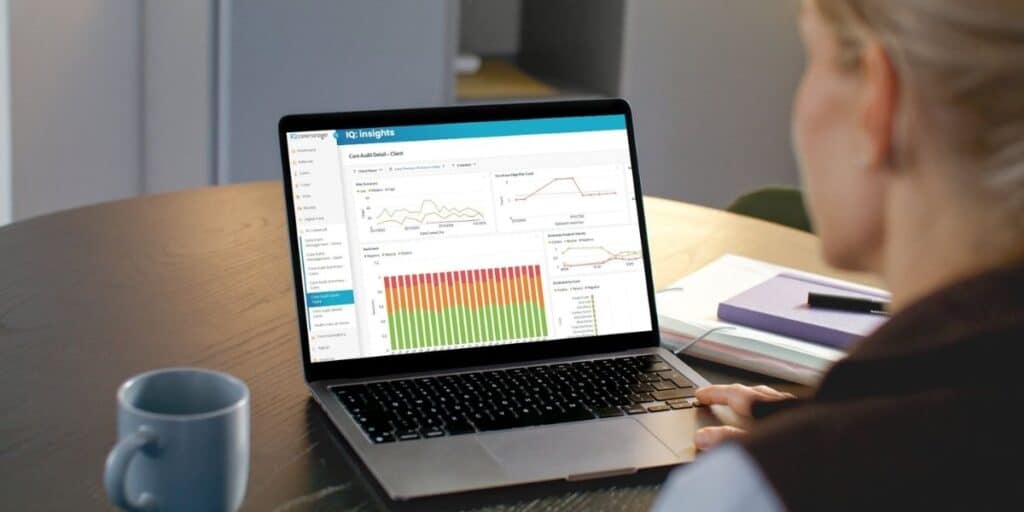
This is exactly where digital care management earns its place. Real-time visit logging, digital care plans, and secure record-keeping turn compliance from a periodic scramble into something demonstrable at any moment. Automated auditing of visit notes, through tools like IQ:careaudit, helps identify risks and flags issues before they escalate, rather than after an inspector finds them. And genuine two-way communication between the office and carers keeps everyone aligned on the standard of care being delivered.
At Unique IQ, this is the problem we have spent over two decades helping providers solve, with home care software built for Irish providers that has inspection readiness and auditability designed in, not bolted on. As Irish providers prepare for a regulated future, having the right foundations in place makes the transition far less daunting.
Final thoughts
Home support regulation in Ireland is the biggest change the sector has seen, and it is a positive one. It raises standards, protects the people receiving care, and rewards providers who take quality seriously. The window between now and commencement is the time to get ready, calmly and thoroughly, rather than reacting under pressure later.
If you would like to understand how the right software can support your journey to registration and inspection readiness, we would be glad to talk it through. Contact us here.
Home support regulation Ireland frequently asked questions
When does home support regulation come into force in Ireland?
Home support regulation in Ireland is introduced by the Health (Amendment) (Home Support Providers) Bill 2025, which has passed both Houses of the Oireachtas but is not yet in force. It still needs to be signed into law by the President, after which the Minister for Health will set a commencement date for all or part of the Act. Providers should treat the current period as time to prepare rather than assuming an immediate deadline.
Who will regulate home support providers in Ireland?
The Health Information and Quality Authority (HIQA) will be the regulator, through its Chief Inspector of Social Services. The Chief Inspector will maintain the register of providers, carry out inspections, and monitor compliance against HIQA’s national standards and the minimum requirements set out in Ministerial regulations.
Does this apply to Northern Ireland?
No. This Bill applies only to the Republic of Ireland. Northern Ireland is a separate jurisdiction, where domiciliary care is already regulated by the Regulation and Quality Improvement Authority (RQIA) under the Health and Personal Social Services (Quality, Improvement and Regulation) (Northern Ireland) Order 2003. Northern Ireland providers already operate under statutory registration and inspection, so this legislation does not change their obligations.
Will all home support providers need to register?
Yes. Once the legislation commences, it will be an offence to deliver a home support service without being registered, and this applies to public, private and voluntary providers alike. Transitional arrangements are expected to apply for existing providers, who are anticipated to have two years from enactment to apply for initial registration.
How long does registration last?
Initial registration is expected to have effect for three years, after which providers will need to renew. Renewals are anticipated to be assessed against the same criteria as the initial registration, taking account of the provider’s compliance and performance during the registration period.
What will HIQA inspect against?
Providers will be assessed against HIQA’s national quality standards and the minimum requirements set out in Ministerial regulations. In practice this means inspectors will expect to see evidence of strong governance, safe and consistent care delivery, accurate record-keeping, and clear accountability. Where serious breaches are found, enforcement can extend to suspending or cancelling registration.
How can providers prepare for regulation now?
The most effective first step is a gap analysis: compare your current operations, policies and procedures against HIQA’s draft National Standards, identify where the gaps are, and build an action plan. Having digital systems that make compliance demonstrable, such as real-time visit logging, digital care planning, and automated auditing, means you can evidence quality on demand rather than scrambling ahead of an inspection.
See how Unique IQ helps Irish home support providers stay inspection-ready. Book a demo or explore our home care software for Ireland.