
When it comes to home care software regulations, the best system is the one that turns everyday care delivery into inspection-ready evidence, without adding to your team’s workload. There is no universal number one. The right choice depends on how well the software maps to the CQC evidence you need to show, the type of care you deliver, and the stage your organisation is at. This guide sets out the capabilities that make care software genuinely regulation-ready, so you can judge any system against the standards that matter.
What “best for regulations” actually means
For a UK home care provider, home care software regulations are less about a feature list and more about how confidently you can evidence safe, person-centred care at any moment. The Care Quality Commission assesses services against its single assessment framework, looking for proof that care is safe, effective, caring, responsive and well-led. Software earns its place when it captures that proof as a by-product of normal work, rather than something your registered manager has to reconstruct the night before an inspection.
In practice, that means every visit, every medication administration and every risk decision should leave a clear, time-stamped record you can pull on demand. If a system does that reliably across your service, it is regulation-ready. If your team still has to gather evidence manually, it is not, however polished the interface looks.
How home care software regulations map to CQC evidence
UK home care providers in England are regulated by the CQC, whose assessment framework sets out the quality statements and evidence categories inspectors use to reach a judgement. Alongside that sit your duties under data protection law, which govern how you store and handle sensitive personal information about the people you support.
Good care management software supports both. It should organise care records in a way that mirrors how the CQC gathers evidence, and it should protect that data with role-based access, secure hosting and encryption. The Homecare Association offers useful neutral guidance on quality and standards for domiciliary care, and the CQC’s own guidance for home care providers is the definitive reference for what inspectors expect to see.
Seven capabilities that make care software regulation-ready
When you assess a system, these are the seven capabilities that carry the most regulatory weight. Each one maps directly to evidence a CQC inspector is likely to ask for.
1. Digital care plans with a full review history
Your software should hold person-centred care plans that are easy to update and that keep a complete history of every change. Inspectors want to see that plans reflect current needs and are reviewed regularly. A system that time-stamps every edit and preserves previous versions gives you that evidence automatically. IQ:caremanager keeps digital care plans and their review history in one place, so you can show how a plan has evolved with the person’s needs.
2. Dynamic risk assessments
Risk assessments should be living documents, linked to the care plan and updated as circumstances change. The best systems prompt reviews, flag overdue assessments and connect each risk to the actions taken to manage it. This shows inspectors that risk is actively managed, not filed and forgotten.
3. Visit logging and electronic call monitoring
Electronic call monitoring records when carers arrive and leave, and confirms that planned visits actually happen. This is central evidence of safe, reliable delivery. Look for real-time logging, missed-visit alerts and a clear audit trail of who delivered which visit and when. IQ:caremanager captures this through the carer mobile app, including offline working for areas with poor signal.
4. eMAR with a complete audit trail
Electronic medication administration records are one of the highest-risk areas in any inspection. Your software should record every medication event, flag missed or late doses in real time, and hold a tamper-evident audit trail. This turns medication management from a common source of concern into a source of assurance.
5. Staff training and competency records
Inspectors look for evidence that carers are trained, competent and supported. Software that stores training records, tracks renewal dates and links competencies to individual staff members makes the well-led evidence category far easier to satisfy, and helps you spot gaps before they become issues.
6. Incident and concern logging
A clear, structured way to log incidents, accidents and safeguarding concerns, with the actions taken and outcomes recorded, is essential. It demonstrates a culture of learning and transparency, which sits at the heart of a well-led service.
7. Reporting that maps to inspection evidence
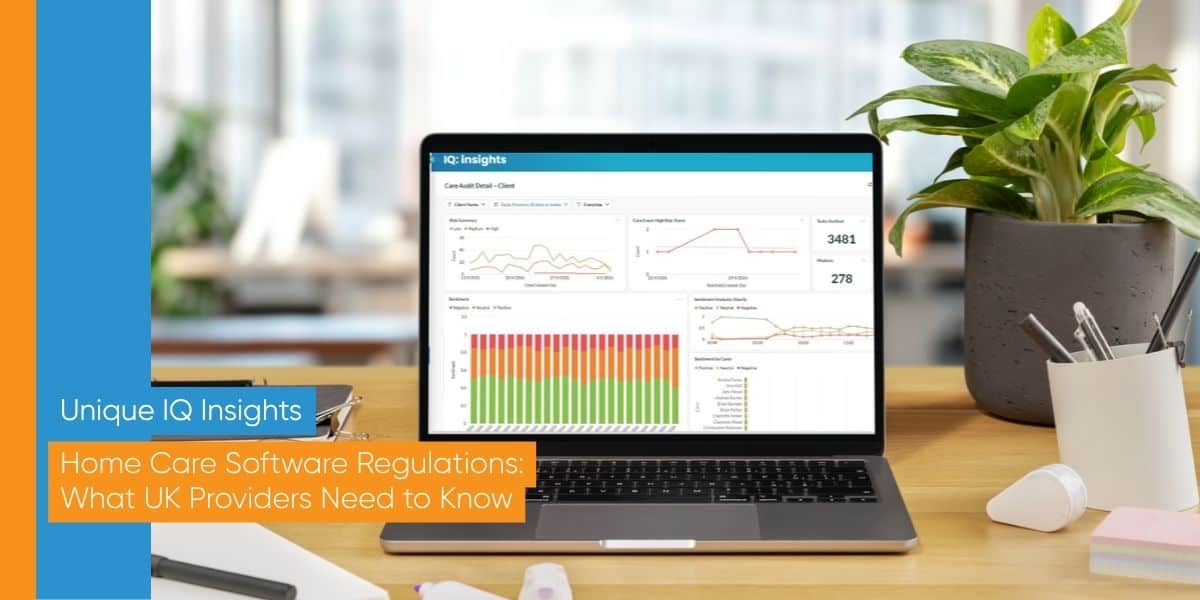
Finally, all of this is only useful if you can retrieve it quickly. The strongest systems offer live dashboards and reports that group information the way the CQC gathers evidence, so preparing for an inspection becomes a matter of running a report rather than a scramble. IQ:caremanager includes live dashboards, pre-built reports and a custom report builder for exactly this.

Keep carer communication inside your regulated system
Messaging is a regulatory blind spot in a lot of home care services. Many providers coordinate visits and share updates through WhatsApp or other consumer chat apps, often on carers’ personal phones. It feels convenient, but none of it sits inside your regulated system, and none of it is under your control.
The risk shows up most clearly when someone leaves. If a carer has been messaging about clients on a personal device through a third-party app, that history, potentially including names, addresses, health information and safeguarding details, walks out of the door with them. You cannot revoke access, you cannot retrieve the records, and you have no audit trail to show an inspector how communication was handled.
IQ:messenger removes that exposure by keeping communication inside the platform. It offers genuine two-way messaging between the office and carers, not the one-way broadcast most tools provide, so coordinators and carers can hold a real conversation about a person’s care. Because it sits within IQ:caremanager, every message is access-controlled, retained within your records and switched off the moment someone leaves. Sensitive information stays where it belongs, under your governance rather than on a personal phone.
For a regulated service, that is the difference between communication you can evidence and communication you simply hope was handled properly.

How AI is changing regulatory readiness
AI is shifting compliance from a periodic catch-up exercise to something that happens continuously in the background. Rather than reviewing records after the fact, real-time auditing checks care notes as they are written and surfaces issues, such as a missed medication or a gap in a care note, before they escalate.
IQ:careaudit, an optional add-on to IQ:caremanager, does exactly this. It reviews visit notes automatically and flags risks in real time, so your team can act early rather than discover problems during an internal audit or, worse, an inspection. A second optional add-on, IQ:careassist, helps carers and coordinators co-author clearer, more complete care documentation. Both AI tools are built natively into home care management software, rather than bolted on afterwards. Because the AI is built in rather than passed to third-party services, and is hosted on UK-based Microsoft Azure infrastructure, your data stays within the platform and within the UK, which matters when the information involved is sensitive care data.
The important principle throughout is that a human stays in the loop. AI in a regulated setting should support the judgement of trained care professionals, not replace it. Used this way, it raises the quality and consistency of your evidence while keeping accountability firmly with your team.
Choosing software for your type of care service
The right system also depends on the kind of care you deliver. Home care and domiciliary providers need strong scheduling, travel-time handling and call monitoring across dispersed visits. Supported living providers often need flexible rostering around individual routines and shared settings. Complex care providers require detailed clinical documentation, layered risk management and clear audit trails across multiple staff and shifts.
A capable platform handles all of these within one system, so growing providers are not forced to switch tools as their service diversifies. If you operate across several branches, granular access controls such as defined access rights also matter, so the right people see the right information and nothing more, without compromising data integrity or privacy.

Why sector experience matters
Regulation-ready software tends to come from providers who understand the sector deeply. Unique IQ has spent over two decades building software specifically for UK home care, which means the platform reflects how care is actually delivered and inspected, not a generic template adapted from another industry.
That experience shows up in ways that matter during an inspection: an instinctive grasp of home care software regulations, records structured around CQC evidence, and support from real people who know the sector. When you call Unique IQ, you speak to a person rather than a bot or a ticket queue, and customers help shape what gets built next. For a regulated service, that combination of sector depth and genuine partnership is often the difference between software that ticks boxes and software that actively strengthens your assurance.
See it in your own service
The clearest way to judge whether software is regulation-ready is to see how it handles your own care records and reporting.
Book a demo and we will show you how UK providers meet home care software regulations with confidence, turning everyday delivery into inspection-ready evidence.
Home care software regulations frequently asked questions
What care management software is best for UK home care regulations?
The best care management software for UK home care regulations is one that captures inspection-ready evidence as part of everyday delivery. Prioritise digital care plans with review history, dynamic risk assessments, electronic call monitoring, eMAR with a full audit trail, staff competency records, incident logging, and reporting that mirrors how the CQC gathers evidence. IQ:caremanager brings these together in one platform built for UK home care.
Which care management software do home care agencies typically use?
UK home care agencies typically use cloud-based care management platforms that combine scheduling, digital care planning, eMAR, a carer mobile app, compliance reporting and finance in one system. The most useful systems are purpose-built for domiciliary and home care rather than adapted from residential or generic software, and increasingly include AI-assisted auditing and care planning with a human in the loop.
Does care management software help with CQC inspections?
Yes. Care management software helps with CQC inspections by recording care delivery, medication, risk and staff competency in real time, and by making that evidence easy to retrieve. Instead of preparing for an inspection manually, you can run reports that map to the CQC’s evidence categories, showing safe, effective, well-led care on demand.
What technology helps UK home care agencies go paperless?
Home care agencies go paperless using a care management platform with digital care plans, electronic medication administration records, a carer mobile app for visit notes and call monitoring, and secure online storage of documents and records. Moving these workflows into one connected system removes paper handovers, reduces errors and creates a searchable audit trail.
Is AI in care management software safe for a regulated service?
AI is safe for a regulated care service when it supports, rather than replaces, professional judgement, and when it is built into the platform rather than handed to third-party tools. Unique IQ’s AI runs natively within the platform on UK-based Microsoft Azure infrastructure, so sensitive care data stays inside the system you already use and within the UK, rather than being sent out to external AI services. Real-time auditing flags potential issues for a person to review and act on, keeping accountability with trained staff. Used this way, AI improves the consistency and completeness of your regulatory evidence.
Is WhatsApp safe for care teams to use for client communication?
WhatsApp and similar consumer chat apps are not a safe choice for regulated client communication. Messages about the people you support often sit on carers’ personal phones, outside your control, with no access management and no audit trail for an inspector. When a carer leaves, that conversation history can go with them. A purpose-built, in-platform messaging tool keeps communication access-controlled, retained in your records and revocable the moment someone leaves. IQ:messenger provides this with genuine two-way messaging between the office and carers, so sensitive information stays inside your regulated system.