
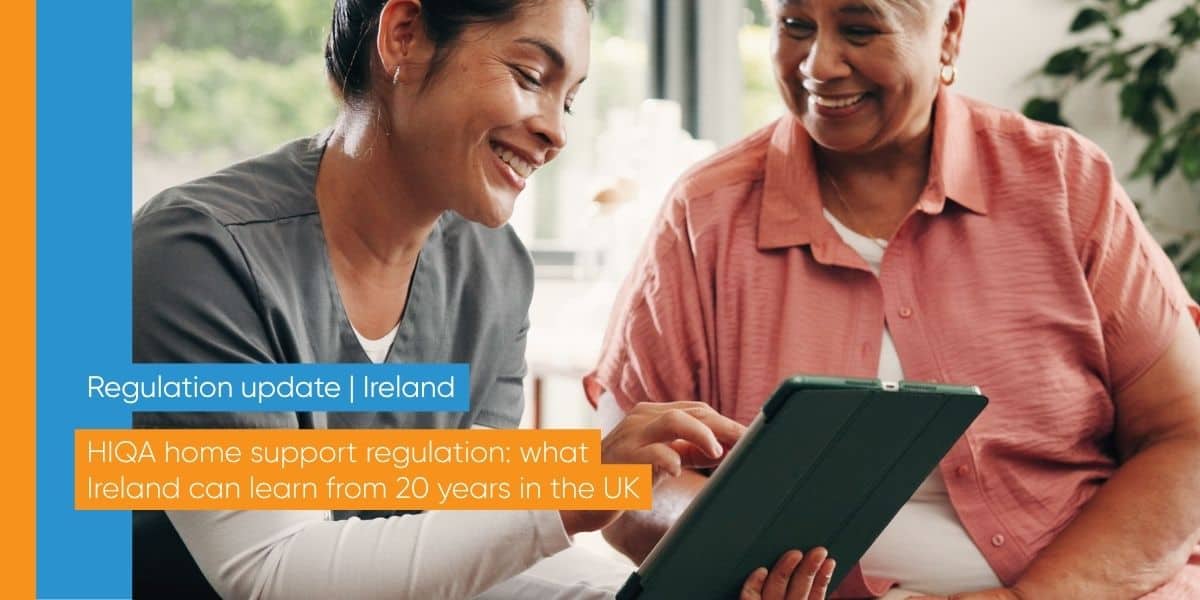
HIQA home support regulation has arrived. For the first time in the history of the State, every home support provider in Ireland will be registered, inspected and held to national quality standards. The Health (Amendment) (Home Support Providers) Bill 2025 has passed both Houses of the Oireachtas and been signed into law. It is the single biggest change the Irish home support sector has faced.
It is also, for anyone who has worked in care software across these islands, deeply familiar. England, Wales, Scotland and Northern Ireland all regulated domiciliary care more than a decade ago, and the pattern that followed was consistent every time. Irish providers have a rare advantage here: they can see the curve before they are on it. The real question is what to do with the roughly two years they have to prepare.
What HIQA home support regulation actually changes
The Act amends the Health Act 2007 and puts HIQA home support regulation in the hands of the Chief Inspector of Social Services, the same office that has registered and inspected nursing homes since 2009. From commencement, registration becomes mandatory, and providing a home support service without it becomes a criminal offence. The Chief Inspector will have the power to grant, refuse, attach conditions to and revoke a registration.
Existing providers get a two-year transitional window from enactment to apply for initial registration, after which registration runs on a three-year cycle. Two details matter for planning. First, the clock starts at enactment, not when the register opens, so the runway is already shortening. Second, the enforceable detail is not written yet.
One change, three rulebooks
HIQA’s home support regulation will be assessed against three distinct things, and it helps to hold all three in view. The primary legislation, now in force, establishes registration, the offence and the powers. The Ministerial regulations, still to be published, will set the minimum requirements a provider must meet, and they are the enforceable floor. HIQA’s National Standards, published in draft in November 2024 with a final version pending, are the quality benchmark that inspection judges you against. Only the first of the three is finished, which leads a lot of providers to a reasonable-sounding but costly conclusion: wait for the detail before starting. We would gently push back on that, and the reason comes from watching the same decision play out in four other markets.
We have seen this film before
Unique IQ builds care management software for home care and home support providers, and we work with providers across the UK and Ireland. Over that time we have watched providers move through registration and inspection under the Care Quality Commission in England, Care Inspectorate Wales, the Care Inspectorate in Scotland and RQIA in Northern Ireland, including through repeated redesigns of the frameworks themselves. Four things happened in each of those markets, and there is little reason to think Ireland will be the exception.
- Regulation does not create more care. It creates more proof of care, and that proof lands on the same small group of people: registered managers, care coordinators and one or two office staff who were already at capacity. Providers who met it with paper files and spreadsheets found that a single inspection could swallow weeks of senior time, and that the cost recurred every cycle.
- The sector consolidates. Registration imposes a fixed cost that barely changes with provider size. A small provider and a large one need broadly the same governance, the same policies and the same evidence. In the UK that squeezed the margins of smaller providers first, and consolidation followed. Ireland’s home care market is already attracting sustained investment, and regulation will accelerate it.
- Recording moves from a chore to an asset. The providers who came through strongest were not the ones with the best-written policies. They were the ones whose everyday systems produced the evidence as a by-product of doing the work: electronic visit verification, digital care records, in-app medication records, live training matrices and audit trails on who changed what and when. When the inspector asked a question, the answer was a report they could run, not a fortnight of reconstruction.
- The regulator moves faster than the sector expects. Frameworks are not fixed. England’s regime has been redesigned repeatedly, including a significant shift in early 2026 towards sector-specific frameworks and away from numerical scoring. Providers who built their compliance around gaming a score found their approach obsolete almost overnight. Providers who built it around genuine, retrievable evidence of quality were unaffected. Ireland’s standards will change too. Build for evidence, not for the current wording.

The real test is not whether you deliver good care
Here is the uncomfortable part. Almost nothing a regulator asks is really about whether you deliver good care. It is about whether you can prove it, retrospectively, at speed, and without warning. That is a systems question, not a care question, and it is where most providers lose ground.
The draft National Standards are written from the perspective of the person using the service and rest on four principles: a rights-based approach, safety and wellbeing, responsiveness, and accountability. Translated into what a provider must actually produce, they ask questions like these. Can you show that a person’s will and preference shaped their support plan, and that the plan changed when their needs did? Can you evidence safe recruitment, Garda vetting, competent staff and the management of risk in a home you do not control? Can you show that a complaint or a changing need produced a change in service, and how quickly? Can you show who is accountable for what, and that your governance does something rather than existing on paper?
None of that is exotic. Almost every requirement in the draft has a direct counterpart in the UK regimes. The wording differs and the terminology is local, but the underlying question is the same one we have helped providers answer for years:
On any given day, can you answer any question about any client without going to look for it?
Why waiting is the most expensive option
Preparing for HIQA home support regulation does not require the final regulations to be published. The temptation to wait for the regulations is understandable, and it is wrong. Roughly four fifths of the work, governance, records, training and audit habits, is knowable now from the draft standards and from every comparable regime. The regulations will refine the final fifth. Providers who start only when the regulations land will be attempting two years of work in whatever is left of the window.
A sensible way to use the transitional period is to treat it as three phases rather than one deadline:
- Spend the first months understanding where you actually stand, with a structured gap analysis rather than a comfortable self-assessment, and name a single person accountable for readiness.
- Spend the middle stretch closing gaps and, crucially, changing habits, moving the evidence base off paper and spreadsheets and onto systems that generate the audit trail automatically.
- Spend the final months applying, expecting that conditions may be attached, and setting the three-year renewal up as a standing rhythm rather than a periodic panic.
Demand is rising at exactly the same time
None of this is arriving in a quiet market. The HSE’s National Service Plan for 2026 targets home support hours around 11 per cent above budgeted 2025 levels, introduces a new measure for people assessed and waiting for support, and commits to a more integrated, data-driven ICT approach across home support and the Nursing Home Support Scheme. With the nursing home sector close to capacity, more demand will keep shifting into home support.
Read those pressures together and the conclusion is stark. Providers are being asked to deliver more hours, to more people, faster, while proving quality to a regulator for the first time and reporting to a commissioner that is itself becoming more data-driven. That capacity does not come from working harder. It comes from removing administrative load from the people delivering care.
Where AI changes the equation
This is the point at which the last two years of technology genuinely change what is possible, and it is where we think Irish providers can get ahead rather than merely keep up.Used well, AI turns HIQA home support regulation into something you can get ahead of rather than merely react to.
Traditionally, evidence of quality has been something you assemble after the fact, pulling records together when an inspection looms. The more useful model, and the one AI now makes practical, is evidence that assembles itself as the work happens and flags problems while there is still time to fix them.
IQ:careaudit is an AI-powered, real-time auditing tool built natively into the Unique IQ platform, not a third-party bolt-on. It reviews visit notes and medication records as they come in, surfaces risks and compliance issues before they escalate, and gives your management team a live view of where attention is needed across the service. Instead of discovering a gap during inspection week, you see it the day it appears. That is the difference between compliance as a periodic project and compliance as an operational habit, and it is precisely the habit that separated the UK providers who thrived from the ones who sold.
IQ:careassist addresses the other half of the burden. AI-assisted, co-authored care planning helps your team produce support plans that are personalised, current and consistent, and that reflect the person’s will and preference, which is exactly the language HIQA’s rights-based principle uses. Combined with electronic visit verification, in-app medication records and live training compliance, the evidence a regulator will ask for becomes a by-product of running the service well, rather than a separate task competing for the same scarce hours.
The terminology will be Irish, and the standards are worded differently from the UK frameworks. But the capabilities that answer them are the ones we have already built and refined through years of CQC, Care Inspectorate Wales, Care Inspectorate and RQIA change. That is the advantage on offer here: not catching up to regulation, but arriving ahead of it.
For providers weighing up their systems now, our home care software in Ireland is built around exactly these evidence requirements, from visit verification to real-time auditing. Request a demo.

Final thoughts
Ireland is not doing something new. It is doing something the rest of these islands did some time ago, with the considerable advantage of being able to read the results first. The providers who find registration manageable will be the ones who decide now that evidence is an operational habit, not an inspection-week scramble, and who put the systems in place to make it one.
We have helped providers navigate exactly this transition, through more framework changes than anyone expected. We would be glad to share what we have learned, please get in touch if we can help.
Frequently asked questions
When does HIQA home support regulation start in Ireland?
The Health (Amendment) (Home Support Providers) Bill 2025 has been signed into law, but the requirements are not live until the Minister for Health issues a commencement order and HIQA opens the register. The Ministerial regulations and the final HIQA National Standards are still to be published. The two-year transitional window for existing providers runs from enactment, so preparation time is already counting down.
Do home support providers have to register with HIQA?
Yes. Once the framework commences, all home support providers, whether public, private or not-for-profit, must register with HIQA’s Chief Inspector of Social Services. Providing a home support service without registration becomes a criminal offence. Existing providers have two years from enactment to apply for initial registration, which then runs on a three-year cycle.
What are the HIQA National Standards for Home Support Services?
They are HIQA’s draft standards, published in November 2024, written from the perspective of the person using the service. They rest on four principles: a rights-based approach, safety and wellbeing, responsiveness, and accountability. The final version is still pending, but the direction is clear and closely mirrors the established UK regimes.
How can home support providers prepare for HIQA registration?
Start now rather than waiting for the regulations. Run a structured gap analysis against the draft standards, name a single person accountable for readiness, and move your evidence base off paper and spreadsheets onto systems that generate an audit trail automatically. Around four fifths of the work is knowable today from the draft standards and comparable regimes.
Does this apply to all home care providers in Ireland?
It applies to services supporting older people and people with disabilities aged 18 and over in their own homes. There is no exemption based on the size of the provider or how the service is funded, so small providers face broadly the same registration requirements as large ones.

Get ahead of the curve with AI-powered compliance.
See how IQ:careaudit and the Unique IQ AI suite turn evidence into a by-product of good care, so quality proves itself in real time. Explore the AI suite, or talk to our team about where your evidence base sits today. sales@uniqueiq.co.uk | 0800 888 6868