

Medication management is one of the highest-stakes activities in home care, and one of the areas where the gap between good and poor practice can have the most serious consequences. This is exactly why eMAR home care software has become such an important tool for agencies. The people receiving care in their own homes are often managing multiple medications with complex regimens, and the consequences of errors, including missed doses, wrong medications, incorrect timing and unrecognised side effects, can be severe.
For many years, the paper MAR chart was the primary tool for managing medication administration in home care. Familiar and simple in concept, the paper chart has significant practical limitations that create risk: it cannot alert a manager when a medication is missed in real time; it can be illegible, incomplete or inaccurate; it requires a physical visit to review; and it provides no automated audit capability.
Electronic Medication Administration Records, known as eMAR, replace the paper chart with a real-time digital system that guides carers through administration, records at the point of care and automatically alerts managers when something needs attention. This comprehensive guide explains how eMAR works, why it matters and what to look for in a home care eMAR solution.
What is eMAR home care software, and how does it work?
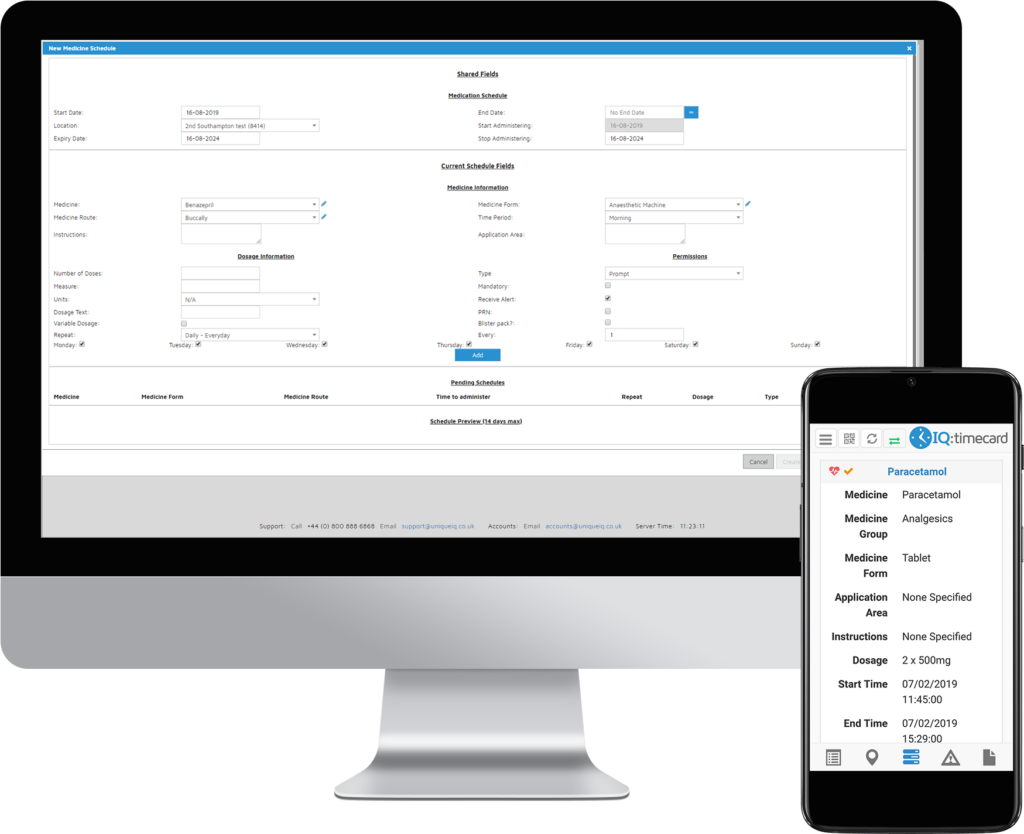
eMAR is a digital system for recording the administration of medications to individual clients. Rather than a carer initialling a paper chart at the time of administration, they access the client’s medication record through their mobile app, work through the prompted administration sequence and confirm the administration – or record a non-administration and the reason – digitally.
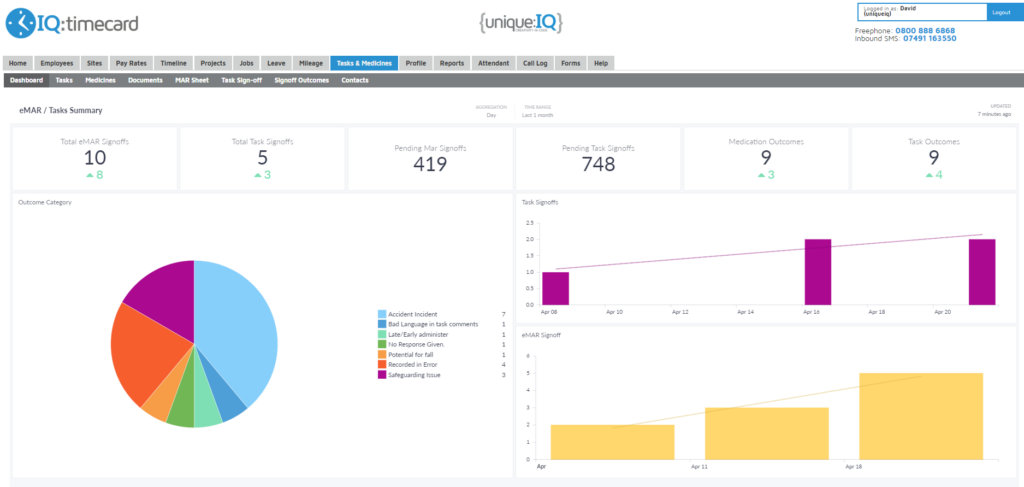
The record is created at the point of care, timestamped and attributed to the specific carer. It is immediately visible to managers in the office through the management platform. If a medication is not administered within the expected time window, an automated alert is generated. If a carer records ‘refused’ or ‘client not in’, the manager is notified and can take appropriate action.
The medication history for each client – every administration, every exception, every alert and every follow-up action – is maintained in a complete, searchable audit trail. This record is accessible in seconds, regardless of which carer attended on any given day, and can be shared with healthcare professionals, the client’s family or the CQC as required.

Why paper MAR charts fall short
The limitations of paper MAR charts are well-documented and have direct safety implications. National guidance, including NICE guideline NG67 on managing medicines in the community, sets clear expectations for how administration should be recorded, expectations that paper charts struggle to meet consistently. The most fundamental problem is that a paper chart can only be reviewed when someone physically accesses it – either at the client’s home or in the office, if the chart is also stored there. A missed medication on a Monday morning may not be identified until a coordinator calls the client or a carer next visits, potentially days later.
Legibility and completeness are chronic issues. Carers working under time pressure may initial ambiguously, record the wrong time or omit recording entirely, intending to complete the chart retrospectively. Handwriting varies; abbreviations are not always standardised; and the physical chart can be misplaced, damaged or incorrectly filed.
From a management perspective, monitoring medication compliance across a caseload of 30 or 50 clients using paper MAR charts is an enormous administrative task. Identifying patterns – a specific client whose medication is regularly late, a particular carer who is not following administration protocols – is practically impossible without hours of manual review. Digital eMAR makes this monitoring instantaneous.
Key features of good eMAR software
A well-designed eMAR system for home care should include a comprehensive, structured medication record for each client showing all current medications, dosage, timing and administration method. It should provide step-by-step administration prompts to guide carers through each medication, reducing the risk of error from rushing or unfamiliarity.
The system should support PRN (as-required) medication protocols with appropriate prompts and recording requirements. It should handle controlled drug recording with the enhanced audit trail that these medications require. It should generate automated alerts for missed medications, refused medications and any recorded concerns, directing these alerts to the appropriate manager in real time.
The audit trail should be complete and immutable: every record created, every amendment made and every alert generated should be permanently logged with the identity of the responsible user and a timestamp. This creates the forensic medication history that may be required in a safeguarding investigation or a CQC inspection.
eMAR and the CQC
Medication management is one of the most consistently scrutinised areas of a CQC home care inspection. Under the Safe key question, inspectors look specifically at how medicines are managed: how prescriptions are received and stored, how administration is carried out and recorded, how errors are identified and responded to, and what learning follows any medication incident. These expectations are set out in the CQC’s guidance on managing medicines for home care providers, which carers and managers are expected to follow.
A provider using eMAR can demonstrate, in real time and with certainty, the complete medication history for every active client. Inspectors can see exactly when each medication was administered, by which carer, whether there were any non-administrations, how those exceptions were flagged and what action was taken. This level of transparency and accountability is considerably more difficult to achieve with paper records.
Agencies that have moved from paper MAR charts to eMAR consistently report improvements in their medication-related CQC evidence, reduced medication error rates and greater confidence among managers in the safety of their medication management processes. The investment in eMAR is, for most agencies, one of the most clearly justified elements of a care management software investment. Strong medication records are also a core part of wider CQC inspection readiness, so getting eMAR right supports your evidence across the Safe key question and beyond.
Training carers to use eMAR effectively
The benefit of eMAR is only realised if carers use it correctly and consistently. Rushed, incomplete or inaccurate eMAR recording creates a different kind of risk from paper, one that is potentially harder to detect because the digital records appear complete even when the underlying practice is poor.
Carer training for eMAR should cover not just how to use the system technically but why accurate recording matters. Carers who understand that their eMAR records are a direct contribution to client safety, and that their records may be reviewed by managers or healthcare professionals, take the task more seriously than those who see it as administrative compliance.
Practice scenarios are valuable: giving carers realistic, slightly challenging scenarios to work through in a training environment before they encounter them in a client’s home builds confidence and surfaces misunderstandings before they become real errors. Competency assessments for eMAR, checking that carers can navigate the system correctly and record accurately, should be part of the standard induction process and refreshed periodically.

Integration with care planning
eMAR is most powerful when it is fully integrated with the broader care planning and management system rather than functioning as a standalone tool. Within IQ:caremanager, eMAR sits alongside care plans, visit records and risk assessments in a single platform, so the connection between a client’s overall care and their medication management is immediately visible.
A care manager who can see in a single view that a client’s care plan indicates declining appetite, that their recent care notes mention confusion, and that their eMAR shows two missed doses of a key medication in the past 48 hours, has a much richer picture of a developing situation than one who must consult three separate systems to gather the same information.
This integration also supports continuity when different carers attend. A carer arriving for a visit can see not just the medication schedule but any notes from the previous carer about the client’s presentation, any concerns raised and any communications from the office, all in the same place as the eMAR prompt.
Choosing the right eMAR home care solution
When evaluating eMAR solutions for your agency, look for functionality that is specifically designed for the home care context rather than adapted from a hospital or residential care system. Medication administration in a client’s own home has different practical realities, the carer is working alone, the equipment is the client’s own, the environment is variable, and the system needs to reflect this.
Look for a carer interface that is fast and simple to use under the time pressures of a busy visit schedule. Complex, multi-screen eMAR workflows create the conditions for rushed recording; simple, guided workflows encourage accuracy. Ensure the system works offline: carers should be able to access the medication record and record administration even without a data connection, with the record syncing when connectivity is restored.
eMAR Home Care Frequently Asked Questions
What is eMAR in home care?
eMAR stands for Electronic Medication Administration Record. It is a digital system that replaces the paper MAR chart, guiding carers through each medication and recording administration at the point of care. Every entry is timestamped, attributed to the carer and immediately visible to managers in the office.
Why are paper MAR charts a risk in home care?
A paper MAR chart can only be reviewed when someone physically accesses it, so a missed medication may go unnoticed for days. Charts can also be illegible, incomplete or misfiled, and monitoring medication compliance across a large caseload by hand is extremely difficult. These limitations have direct implications for client safety.
How does eMAR help with CQC inspections?
Medication management is one of the most closely scrutinised areas under the CQC’s Safe key question. With eMAR, a provider can show the complete medication history for every client in real time, including when each dose was administered, by whom, and how any exceptions were flagged and resolved. This level of transparency is much harder to achieve with paper records.
Does eMAR work without an internet connection?
A good home care eMAR system works offline, so carers can access the medication record and log administration even without a data connection. The record then syncs automatically once connectivity is restored. This matters because carers often work in homes with limited or no signal.
Unique IQ’s eMAR functionality is fully integrated within IQ:caremanager, giving managers real-time visibility of medication records across their entire caseload and giving carers a clear, guided recording process through IQ:careplanner.
Next step: See Unique IQ’s eMAR in action – book a demonstration to understand how it works in a home care context.