
Key takeaways
- Care audit software checks care records against agency policy and regulatory standards, so providers can monitor care quality and evidence it on demand rather than assembling proof before an inspection.
- The biggest shift in 2026 is from periodic manual checklists to real-time auditing, where records are reviewed as they are created rather than sampled once a month.
- For UK home care, the value sits in coverage: auditing every client, every visit, across multiple branches, rather than a small sample.
- Good care audit software supports CQC inspection preparation and Regulation 17 governance, but it supports your team’s judgement rather than replacing it.
For UK home care providers, the hardest part of an inspection is rarely the quality of care itself. It is proving that quality on demand, across every client and every branch, without losing a fortnight to preparation. Care audit software exists to close that gap. This guide explains what it is, how it works, what to look for in 2026, and how it fits alongside the rest of your care management system.
It is written for home care managers and compliance leads across home care, domiciliary care, supported living and complex care. Unique IQ has supported UK providers for over two decades, and the guidance below reflects what we see work in real agencies.
What is care audit software?
Care audit software is a digital tool that checks care records against your agency’s policies and the standards you are regulated on, so you can monitor care quality and evidence it when asked. It reviews the information your team already records, such as visit notes, medication records and care plans, and flags where something has been missed, has drifted from the plan, or needs attention.
Traditional auditing in home care means sampling: a proportion of visit notes reviewed each month, a selection of MAR charts checked by hand. Care audit software changes both the scale and the timing of that work. Instead of a monthly sample, it can check every record. Instead of a retrospective review, the better systems check records in real time as they are submitted. That shift, from sampling to coverage and from retrospective to real-time, is what separates modern care audit software from a digital checklist.
Why UK home care providers use care audit software
The core reason is the distance between recording something and being able to evidence it. Your carers record visits, your coordinators update care plans, and the information exists. But when an inspector or commissioner asks how many clients have had a specific risk assessment reviewed in the last six months, answering that from a system that only stores records means opening them one at a time.
Care audit software turns recorded information into evidence you can retrieve. In practice, providers use it for four things:
- Care quality monitoring across the whole client base, not just a monthly sample, so you can speak for every visit rather than the handful you reviewed.
- CQC inspection preparation, by building a continuous, time-stamped evidence trail as care is delivered, so proof is there when you need it.
- Early risk detection, catching missed medications, overdue reviews or safeguarding signals when they happen rather than at month end.
- Consistency across branches and services, applying the same audit criteria everywhere so a multi-branch group is measured the same way throughout.
How care audit software supports CQC readiness
Under the CQC Single Assessment Framework, assessment has moved from a one-off inspection to continuous monitoring against the five key questions of safe, effective, caring, responsive and well-led. Assessors draw on six evidence categories, including processes and outcomes, and each registered location is assessed on its own. That raises the bar for evidence: a folder assembled the week before a visit no longer reflects how you are actually assessed.
Care audit software helps in two specific ways. First, it builds evidence continuously, so the proof of safe, person-centred care accumulates as care is delivered rather than being created under pressure. Second, it directly supports Regulation 17 (Good Governance), the regulation most commonly breached in services rated Requires Improvement, which requires providers to run systems that identify where quality or safety is being compromised and act without delay. Real-time auditing is exactly that kind of system.
One important boundary: care audit software supports your compliance, it does not replace your team’s judgement. Findings still need a person to review them and decide what to do. The software makes being inspection-ready an everyday state rather than a scramble, but the responsibility stays with you.
What to look for in care audit software in 2026
Not every product described as care audit software does the same job. Some are template and checklist tools designed for scheduled internal audits. Others audit the live care record itself. When you are comparing options, these are the features that matter most for home care:
- Coverage, not sampling. Can it check every record, or only support a manual sample? At scale, sampling becomes a statement about your capacity rather than your quality.
- Real-time flagging. Does it review records as they are submitted, or only on a reporting cycle? Timing is the difference between preventing an issue and documenting one.
- Care plan awareness. Does it check what was delivered against each person’s own care plan, or only against generic rules? Context is what tells you whether care was right for that individual.
- Per-location and per-service reporting. Can evidence be filtered to a single registered location and service type? A group total is not evidence for a single branch inspection.
- A clear audit trail. Does it record who did what and when, capture amendments as well as original entries, and export in a form you would be comfortable handing to an inspector?
- Human oversight built in. Are findings closed by a named person with a reason, rather than resolved automatically? Accountability matters under inspection.
Where care audit software fits in your care management system
Care audit software is most useful when it is part of your wider care management platform rather than a separate tool you copy data into. When auditing sits on the same system as your care planning, scheduling and records, it can check the live record as it is created, with no extra step for carers and no reconciliation for coordinators.
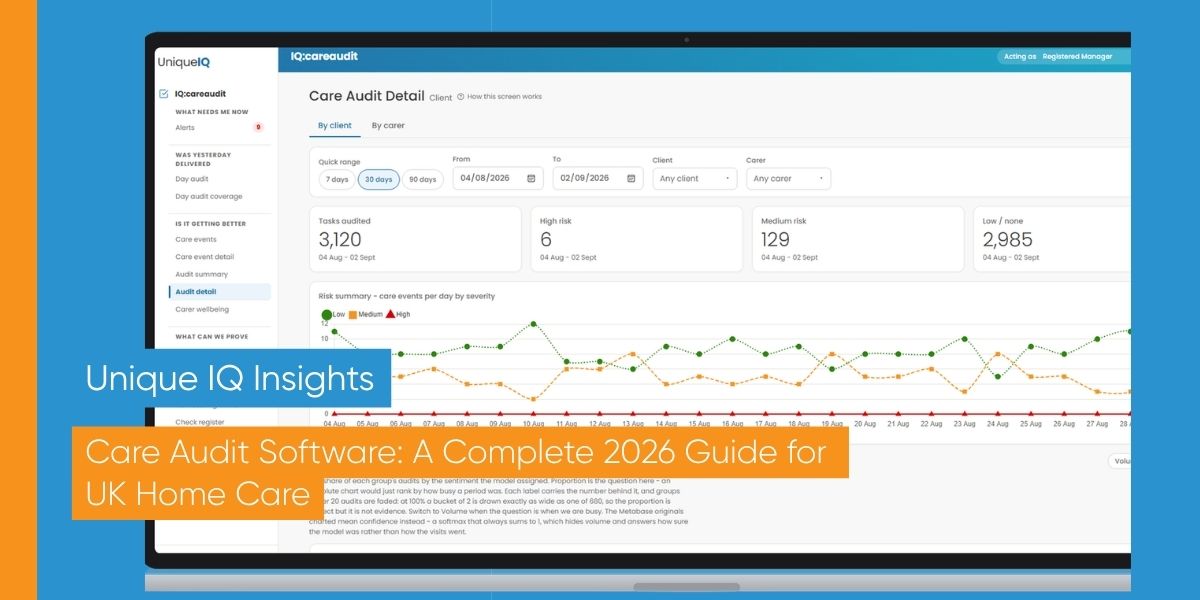
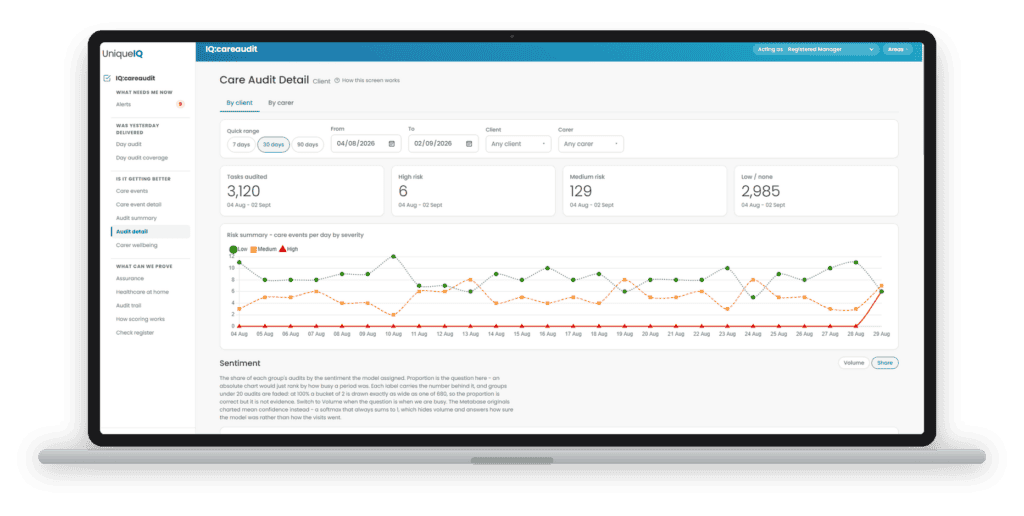
IQ:careaudit, is an example of this approach. It uses AI to audit the whole care day, checking the care delivered against each person’s own care plan and reviewing visit notes, medication records and visit logs in real time. It runs more than 40 rules and signals across the entire client base every day, flagging care that has drifted from the plan, upcoming or overdue reviews and key dates, safeguarding or compliance signals in the notes, and early signs of carer strain. Nothing is closed automatically: every finding is picked up and closed by a named person, with a reason.
Because it works on the records your team already keeps, real-time care audit software of this kind adds nothing to a carer’s visit while giving managers a continuous, inspection-ready picture of the whole service.

See IQ:careaudit in action
Unique IQ has supported UK home care providers for over two decades, across home care, domiciliary care, supported living and complex care. IQ:careaudit is available as an optional add-on to our care management software, auditing the whole care day in real time so you can monitor care quality across every client and stay inspection-ready every day.
Book a demo to see care audit software running on real care records. Call 0800 888 6868 or email sales@uniqueiq.co.uk
Care audit software frequently asked questions
What is care audit software?
Care audit software is a digital tool that checks care records against your agency’s policies and regulatory standards, so you can monitor care quality and evidence it on demand. It reviews information your team already records, such as visit notes, medication records and care plans, and flags where something has been missed or has drifted from the plan. Modern systems do this in real time as records are submitted, rather than through periodic manual reviews.
How does care audit software help with CQC inspection preparation?
It builds a continuous, time-stamped evidence trail as care is delivered, so the proof of safe, person-centred care is there whenever you need it rather than assembled before a visit. Because it can check every client every day, it supports the kind of ongoing evidence the CQC Single Assessment Framework now expects across the Safe, Effective and Well-led areas, and it supports Regulation 17 governance requirements.
Does audit software replace manual auditing?
It replaces the need to rely on manual sampling, but it does not replace your team’s judgement. The software surfaces findings across your whole client base; a named person still reviews each one and decides what action to take. The shift is from spending time finding issues to spending time acting on them.
What is the difference between auditing software and a compliance checklist tool?
Checklist tools digitise scheduled internal audits, replacing paper forms with structured templates. Care audit software that audits the live care record goes further, checking the actual care delivered against each person’s care plan as it happens, rather than at set audit points. Both have a place, but only the latter gives you continuous coverage of every visit.
Is care audit software suitable for multi-branch home care providers?
Yes, and it is often where the value is greatest. Applying the same audit criteria centrally, across every branch and service, means a group is measured consistently rather than through six branches each auditing themselves differently. The important feature to check is whether evidence can be filtered to a single registered location, since each is assessed individually at inspection.
Does care audit software work across different care services?
Good care audit software accounts for the fact that domiciliary care, supported living, complex care and reablement are recorded and inspected against different expectations. Look for a system that can apply consistent central criteria while allowing legitimate variation by service type, rather than measuring everything against one template.