
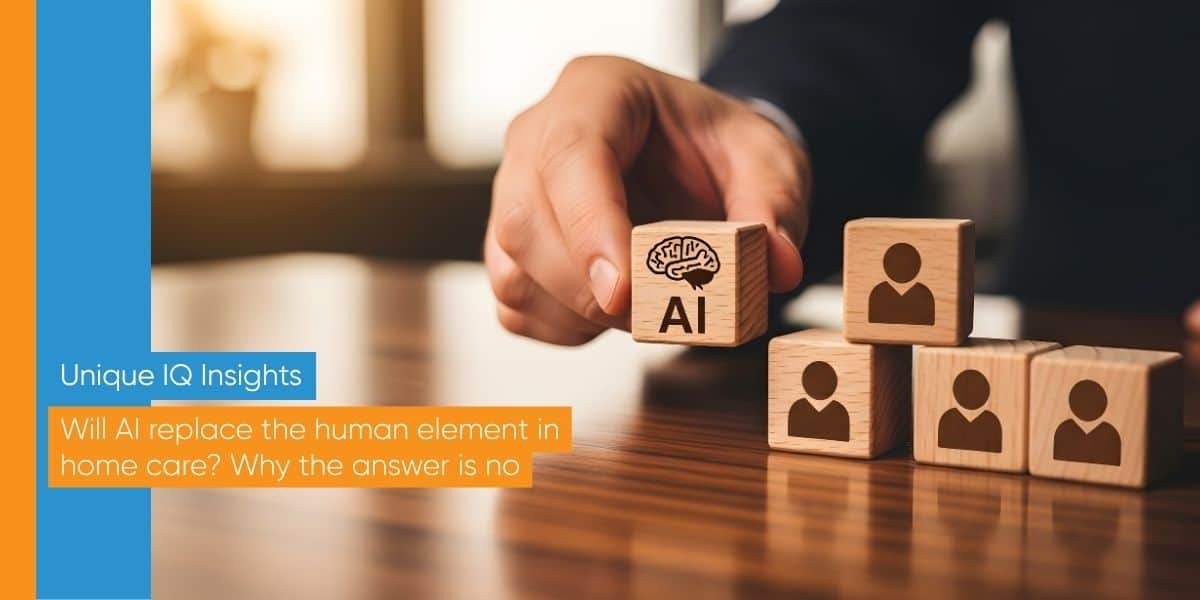
When we speak to care providers about AI in home care, the same question comes up again and again: will it replace the human element? From where we stand, the answer is a firm no. But it’s a question worth taking seriously, because the way you answer it shapes the kind of technology you choose to bring into your service.
Why the fear is understandable
Care is a human profession. It runs on relationships, judgement, and the kind of instinct that comes from knowing a person well. So when the conversation turns to artificial intelligence, it’s natural for care leaders to feel cautious. Nobody wants to see decisions about vulnerable people handed over to a machine, and nobody should.
The concern often comes from how AI is talked about elsewhere. In many sectors, the pitch is automation for its own sake: fewer people, faster outputs, less human involvement. In care, that framing gets it exactly wrong. The goal was never to remove the people. It was to give them back their time.
The real problem AI should be solving
Ask most care coordinators and managers where their day goes, and the answer rarely involves the work they trained to do. It goes on admin. Writing up care plans, chasing paperwork, reviewing visit notes, checking for the small errors that can turn into big problems.
This is where AI in home care earns its place. Not by making decisions, but by lifting the administrative burden that pulls skilled people away from care. When the routine heavy lifting is handled, coordinators and managers get more time for the judgement calls, the relationships, and the oversight that only a person can provide.
That’s the shift worth making: from technology that replaces people to technology that frees them.

Keeping humans firmly in the loop
Every AI tool we build at Unique IQ is designed around one principle: the person makes the decision, always.
IQ:careassist co-authors care plans, giving coordinators a strong, structured starting point to review and refine. It doesn’t finalise anything on its own. The professional judgement stays with the professional.
IQ:careaudit reviews visit notes and medication records in real time and flags potential issues for managers to assess and act on. It doesn’t close cases or make calls about care. It surfaces what needs attention, so nothing important slips through, and leaves the response in human hands.
In both cases, the AI does the heavy lifting and the people make the decisions. That’s not a limitation of the technology. It’s the point of it.

What responsible AI in care actually looks like
Responsible AI isn’t innovation for its own sake. It’s practical, it’s accountable, and it keeps professional judgement at the centre. A few principles matter here:
The AI supports, it doesn’t decide. Every meaningful output is reviewed and owned by a qualified person.
It targets the right problem. Good AI removes admin and surfaces risk. It doesn’t try to replace the human relationships that make care work.
It earns trust through transparency. Care leaders should always understand what the technology is doing and why, with clear oversight built in.
Get these right and AI stops being a threat to the human element. It becomes the thing that protects it.
Where your data lives matters just as much
Keeping humans in the loop is one half of responsible AI. The other half is knowing exactly where your data goes and who governs it. This is where a lot of AI tools fall short, and where care leaders should ask hard questions.
Many AI features on the market route your data through third-party services, often hosted overseas, with limited transparency about how information is stored, processed, or used to train external models. For a sector handling sensitive personal and health data, that should give any care leader pause.
Unique IQ takes a different approach. Our AI runs within our own platform, hosted in the UK on Microsoft Azure. Your data stays inside the system you already trust, under UK data protection standards, rather than being passed out to external AI tools you have no visibility over. IQ:careassist and IQ:careaudit are built natively into the platform, not bolted on, which means governance, security, and access controls apply consistently across everything you do.
For providers thinking seriously about AI adoption and how it maps to CQC expectations around being Safe, Effective and Well-led, this matters. We have set out our full approach in our white paper, Governance, Safety and Readiness for AI in Care, which includes a practical readiness checklist and guidance on aligning AI use with the CQC quality statements. You can download the white paper here.

Final thoughts
The question of whether AI will replace people in care deserves a straight answer, and ours is no. Used well, AI does the opposite. It clears the admin that gets in the way, flags the risks that matter, and hands time and attention back to the people delivering care. That’s what responsible, practical AI looks like: not tech for its own sake, but tools that genuinely free up time and improve outcomes.
Want to see human-led AI in action? Book a demo of IQ:careassist and IQ:careaudit and see how they support your team without ever replacing their judgement.
AI in home care frequently asked questions
Will AI replace carers or care staff?
No. Responsible AI in home care is designed to remove administrative work, not to replace people. Tools like IQ:careassist and IQ:careaudit keep humans firmly in the loop, so coordinators and managers keep full control over decisions while the technology handles the routine heavy lifting.
What does “human in the loop” mean in care software?
Human in the loop means a qualified person reviews and owns every meaningful output from the AI. The technology can draft a care plan or flag a potential issue, but it never finalises decisions on its own. Professional judgement always stays with the professional.
How does AI actually help home care providers?
AI helps by lifting the admin burden that pulls skilled staff away from care. It can co-author care plans for coordinators to review, and review visit notes in real time to surface risks for managers to assess. This gives care teams more time for relationships, oversight, and the judgement calls only a person can make.
Is AI in care plans safe?
It is safe when the AI supports rather than decides. With IQ:careassist, the tool provides a structured starting point that a coordinator reviews and refines before anything is finalised. The professional remains accountable for the final care plan.
Where is Unique IQ’s AI data hosted?
Unique IQ’s AI runs within its own platform, hosted in the UK on Microsoft Azure. Your data stays inside the system rather than being routed out to third-party AI tools, so it remains under UK data protection standards with consistent security and access controls.
Is AI in care software compliant with UK data protection and CQC expectations?
It can be, provided the AI is governed properly. Unique IQ keeps AI processing inside its UK-hosted platform and has published a white paper on Governance, Safety and Readiness for AI in Care that helps providers align AI use with the CQC quality statements around being Safe, Effective and Well-led.
How is Unique IQ’s AI different from other AI tools in care?
Unique IQ’s AI is built natively into the platform and hosted in the UK on Microsoft Azure, rather than relying on third-party services that may process data overseas. This gives providers clear visibility and control over where their data goes and how it is governed.
What is the difference between IQ:careassist and IQ:careaudit?
IQ:careassist co-authors care plans, giving coordinators a strong draft to review and refine. IQ:careaudit reviews visit notes and medication records in real time and flags potential issues for managers to assess and act on. Both were built natively into the Unique IQ platform and were first to market in homecare software.