

A modern care audit checklist looks very different to the paper-based reviews UK home care agencies relied on a decade ago. Rather than waiting for a periodic manual review to identify concerns, today’s care audit tools check records as they are submitted, flagging issues before they escalate and building continuous CQC evidence in the background.
But what should your care audit checklist actually be checking? Here are the 12 most important real-time care audit checks every UK home care agency should have in place, and how IQ:careaudit from Unique IQ runs them automatically.

1. Incomplete care notes
Every visit should generate a complete care note covering tasks completed, observations about the client’s condition, and any concerns or changes noted. IQ:careaudit flags any visit record that is missing required fields or falls below the expected standard of detail in real time, so managers can follow up with the carer before the end of their shift.
2. Missed or refused medication
Medication errors are one of the highest-risk areas in home care and one of the most scrutinised by CQC inspectors. IQ:careaudit generates an immediate alert whenever a medication is recorded as missed, refused, or administered outside the prescribed time window, giving managers the opportunity to act and document their response before the situation escalates.
3. Missed or late visits
If a carer has not clocked in within the expected window for a scheduled visit, the office should know immediately. Our platform provides automated alerts for missed and late visits via electronic call monitoring, allowing managers to follow up before a vulnerable client is left without care.
4. Changes in a client’s condition or behaviour
Gradual changes in a client’s patterns, such as repeatedly refusing meals, increased agitation, or changes in mobility, can be early indicators of a deteriorating condition or safeguarding concern. IQ:careaudit uses AI to identify these patterns across multiple visits and flag them for management review before they escalate, catching concerns that a manual batch review might miss entirely.
5. Safeguarding indicators in your care audit checklist
Your care audit checklist should monitor notes for language or observations that may indicate a safeguarding concern, whether relating to the client, a family member, or the care environment. IQ:careaudit’s automated flagging of potential safeguarding indicators ensures concerns reach the right person quickly, with a time-stamped record of when the flag was raised and how it was responded to.
6. Care plan tasks not completed
Each visit has a set of tasks defined in the client’s care plan. If a carer has not recorded completion of a required task, IQ:careaudit flags this immediately. This could indicate a time pressure issue, a safeguarding concern, or simply a recording error that needs following up, and the real-time alert means managers can act on the same day.
7. Care plans not reviewed within the required timeframe
Care plans should be reviewed regularly and updated whenever a client’s needs change. IQ:careaudit flags any care plan that has not been reviewed within your agency’s defined review period, ensuring no client’s plan becomes outdated or fails to reflect their current needs.
8. Carers working beyond contracted or safe hours
Overworked carers are more likely to make errors and less likely to deliver consistent, high-quality care. IQ:careaudit monitors hours worked against contracted hours and flags where carers are consistently working beyond safe limits, supporting both staff wellbeing and service quality.
9. Inconsistencies between visit records and care plans
If a carer’s visit notes consistently describe care that differs from what is documented in the care plan, this may indicate the plan needs updating, the carer needs retraining, or there is a systemic issue with how care is being delivered. IQ:careaudit automatically cross-references visit records against care plans to identify these inconsistencies early.
10. Client or family concerns not followed up
Any concern raised by a client or family member should be logged, escalated, and followed up within a defined timeframe. IQ:careaudit flags any concern that has not received a documented response within your agency’s agreed response window, ensuring nothing falls through the gaps.
11. Carer qualification gaps
Some clients require carers with specific qualifications, training, or experience. IQ:careaudit flags any visit where the allocated carer does not meet the qualification requirements defined in the client’s care plan, before the visit takes place where possible, protecting both the client and the agency.
12. Patterns of concern in your care audit checklist
A single incomplete note or missed task may be an isolated error. A pattern of incomplete notes, late arrivals, or missed tasks across a particular carer’s records is a performance and quality issue that requires management intervention. IQ:careaudit identifies these patterns rather than just individual incidents, giving managers the intelligence to act at the right level.
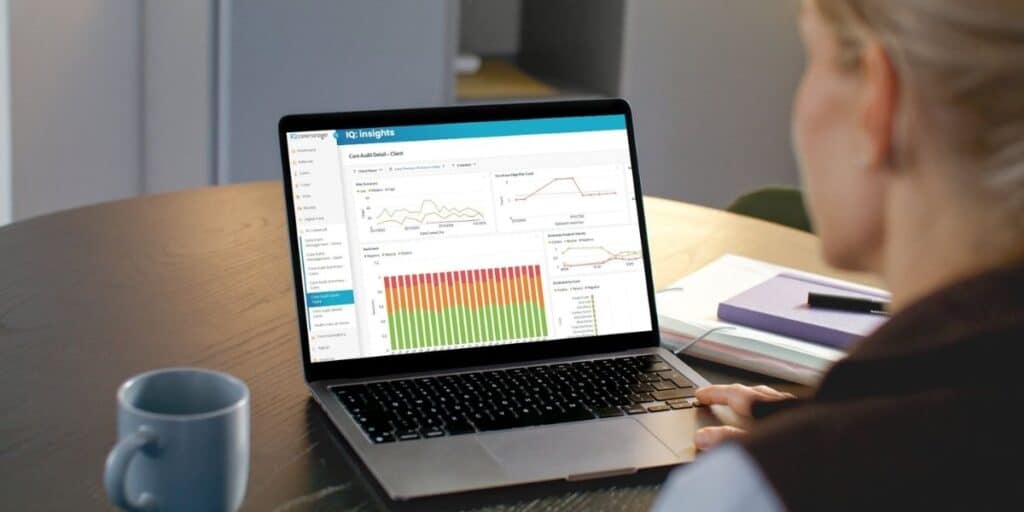
Your care audit checklist in action
The difference between a real-time care audit checklist and a periodic manual review is the difference between preventing a problem and discovering one after the fact. With IQ:careaudit, every one of the 12 checks above runs automatically, every time a care record is submitted, across every client and every carer in your service.
Managers receive instant alerts when concerns are flagged, with a complete audit trail of every check run, every alert generated, and every management action taken in response. This creates the proactive governance evidence that CQC inspectors look for under the Well-Led key question, built automatically into your day-to-day operations.
IQ:careaudit reduces manual auditing time by more than 95%, freeing managers to focus on acting on concerns rather than searching for them. It forms part of Unique IQ’s AI Suite, alongside IQ:careassist for AI-assisted care planning.
Care audit checklist FAQs
What is a care audit checklist?
A care audit checklist is the set of checks a home care agency runs against its care records, medication logs, and visit data to identify quality and compliance concerns. Modern care audit checklists are run automatically and in real time rather than as a periodic manual review.
How does IQ:careaudit work?
IQ:careaudit uses AI to review every care note and visit log as it is submitted, automatically checking against a set of configurable audit rules and flagging concerns to managers in real time. It integrates with the full Unique IQ platform so it has access to care plans, medication records, and visit attendance data simultaneously.
How many checks should a care audit checklist include?
There is no fixed number, but the 12 checks above cover the most common risk areas identified by CQC inspectors. The key is that checks run continuously and automatically rather than periodically and manually.
How does a real-time care audit checklist support CQC inspections?
It creates a continuous, time-stamped evidence trail of proactive quality monitoring, demonstrating the governance systems that CQC inspectors look for under the Well-Led and Safe key questions.
Can a small home care agency use IQ:careaudit?
Yes. The compliance requirements are the same regardless of agency size, and an automated care audit checklist is often more cost-effective than the management time spent on manual reviews. Unique IQ offers packages suited to agencies of all sizes.

Want to see IQ:careaudit in action? Book a personalised demo with Unique IQ and discover how a real-time care audit checklist can transform your compliance and CQC readiness.