

Care technology adoption in adult social care has come a long way in a short time, but the Government’s 2025 Adult Social Care Provider Technology Survey makes clear that the journey is far from over.
Conducted with over 1,000 CQC-registered providers across England, the survey offers a practical snapshot of where the sector actually stands, not where policy hopes it will be. The picture is one of genuine progress, but also of persistent barriers that will not resolve themselves without the right support.
Here is what stood out, and what it means if you are a care provider thinking about your next step.
DSCR adoption has grown significantly, but the gap remains
Digital social care record adoption has risen sharply, from 41% of providers in December 2021 to 80% by July 2025. That is a significant shift in a relatively short period, driven in large part by the government’s Digitising Social Care programme.
But 20% of providers still do not have a DSCR (Digital Social Care Record) in place, and the survey found that more than a quarter of respondents were not using any care technologies at all to deliver care and support. For micro providers (those supporting ten people or fewer), that figure rises to 40%.
The government’s ambition is for all care providers to be fully digitised by the end of this Parliament. The data suggests there is still meaningful work to do.

What the survey tells us about care technology adoption across provider types
Digital rostering was the second most commonly used business management technology in the survey, with 63% of respondents using it. That reflects a broader recognition that scheduling and workforce management are areas where technology delivers clear, measurable value.
However, care technology adoption levels vary significantly depending on provider size. Larger providers are consistently more likely to use digital tools across all categories. Smaller providers face the same operational pressures, often with fewer resources to address them.
Cost is the biggest barrier to care technology adoption
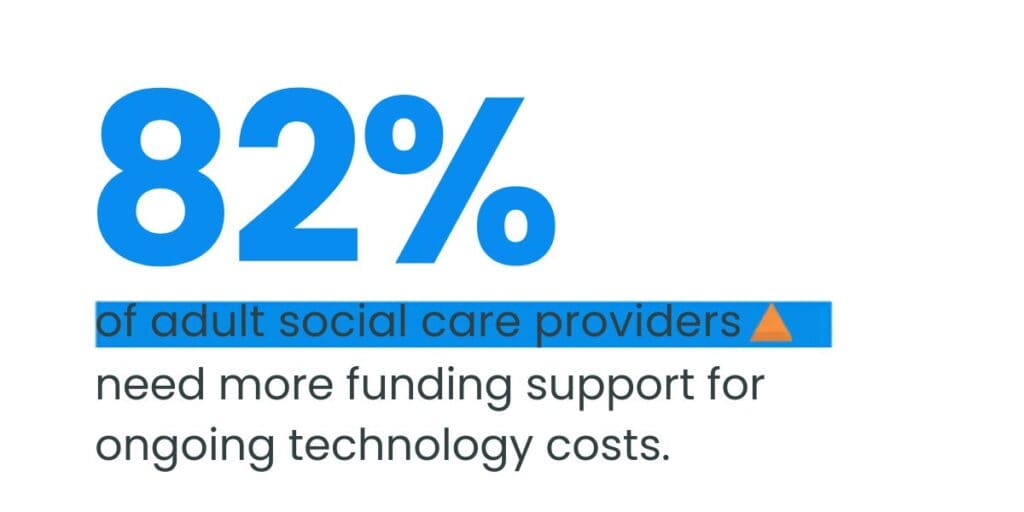
The financial picture is stark. The survey found that 82% of providers need more funding support for ongoing technology costs, and more than two thirds called for more help with upfront investment.
This is not reluctance. Most providers understand the value of going digital. The barrier is practical: in a sector where margins are already tight, finding the budget for new software, training, and infrastructure is genuinely difficult.
Other barriers cited in the survey include internet connectivity, digital skills among staff, and a general wariness about change. A third of residential care providers said they anticipate needing faster broadband within the next three years just to keep up with where technology is heading.
What this means for care providers considering their next step
The survey reinforces something that many care leaders already know: care technology adoption is not a single event. It is a journey, and the right partner makes a significant difference to how that journey goes.
Choosing a software provider that understands the realities of the care sector, not just the technology, matters enormously. That means clear onboarding, accessible support when you need it, and a platform that fits the way your service actually works rather than asking you to work around it.
At Unique IQ, we work with domiciliary care providers across the UK who are at every stage of that journey. Some are replacing paper-based processes for the first time. Others are scaling across multiple branches and need a platform that can grow with them. What they have in common is that they need technology that listens to how they operate, and software that genuinely cares about outcomes.
If the 2025 survey has prompted you to think about where your service sits, we are happy to have that conversation. Book a demo or get in touch to find out how Unique IQ could support your next step.
Further reading:
- Findings from the 2025 Adult Social Care Provider Technology Survey (GOV.UK)
- IQ:caremanager – home care management software built for domiciliary providers